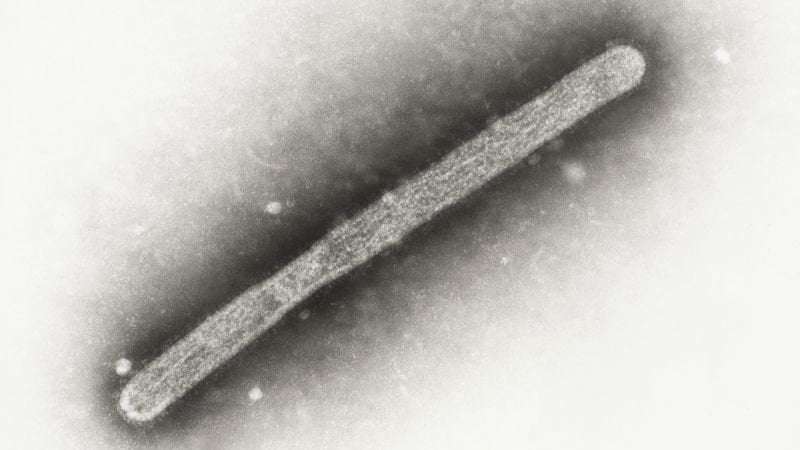
The newer variant of avian influenza that recently infected dairy cattle in Nevada has a genetic change that’s thought to help the virus copy itself in mammals — including humans — more easily, according to a new technical brief from the US Department of Agriculture’s Animal and Plant Health Inspection Service.
It’s unclear whether these viruses pose a bigger threat to people, however. The CDC says the risk of H5N1 to the public is still low, although people who work on farms or who have backyard flocks are at higher risk.
The USDA report comes as a dairy farm worker in Nevada has screened positive for H5N1, the first human infection identified in the state. The worker’s symptoms include red, inflamed eyes, or conjunctivitis, according to a source familiar with the details who was not authorized to speak to the media. The US Centers for Disease Control and Prevention is working to confirm the initial positive test.
Scientists are closely watching the new infections in Nevada because gene sequences from affected cattle have shown that they are a subtype of the H5N1 virus, D1.1, which has been associated with two severe human infections in North America, including one death.
The affected herds, in the same valley in Churchill County, are the first known instances of spillover from D1.1 into cattle. The strain had previously been found only in birds and people.
Most bird flu infections in dairy cattle in the US have been the B3.13 variant, or what’s become known as the “cattle clade.” Researchers aren’t sure how the D1.1 variant was transmitted to the Nevada cows. Dairy farmers with infected herds reported large die-offs of wild birds near their farms before their cows got sick, according to the USDA.
That led investigators to believe that the cows encountered infected birds, or perhaps their droppings, and caught the virus that way. Wild birds are hard to control on farms, where a feed trough filled with grain can look like a giant birdfeeder.
Gene sequencing of these D1.1 viruses has found a mutation that helps the virus copy itself more efficiently into the cells of mammals, including people.
This change hasn’t been seen in other D1.1 infections in wild birds or poultry, according to the USDA. It raises the possibility that another animal, perhaps a cat or fox, brought the virus onto these farms.
“This mutation … provides the virus with the ability for enhanced replication, which poses a threat to humans that are exposed to these cows,” said Dr. Seema Lakdawala, a microbiologist and immunologist at Emory University, who has been studying how H5N1 has been spreading in dairy herds.
When viruses change, or mutate, they do it in one of two ways: a drift or a shift.
Drifting refers to a small change to the genome, usually a mistake, that the virus makes when it copies itself in a cell. Most of the time, these changes are harmful to the virus or have no effect. Occasionally, a small change can help the virus become more fit and outcompete those around it, helping it become a more dominant variant.
A shift is a bigger change. Flu viruses have eight segments of their genome. When two different flu viruses infect a cell at the same time, they can swap whole segments of their genomes to create hybrid viruses that may have dramatically different properties.
D1.1 is a new clade that was created by a shift, so it is a hybrid virus. Half of its segments, including its “H” segment, come from a highly pathogenic H5N1 virus that was carried into North American by wild birds traveling from Asia sometime after April 2022. The other half, including the “N” segment, comes from a low-pathogenic flu virus that was already present in birds in North America.
D1.1 was first detected in wild birds September 2024, according to the USDA, and is now the dominant H5N1 lineage in wild birds in North America.
In late October, the D1.1 subtype was confirmed in workers who were depopulating birds on a farm with infected poultry in Washington state. Though these workers reportedly developed respiratory symptoms, their infections were described as mild.
A few weeks later, in early November, a 13-year-old girl in British Columbia, Canada, also tested positive for H5N1’s D1.1 strain and became severely ill and experienced multiple organ failure. She survived, but only after weeks of intensive care. Public health officials conducted an extensive investigation, but they still don’t know how she was exposed to the virus.
When scientists sequenced the genome of the H5N1 virus that infected her, they found signs that it had begun to develop the kinds of mutations it would need to become a more efficient human pathogen.
Then, in December, a person over age 65 in Louisiana who was exposed to sick birds in their backyard also became seriously ill with D1.1 and was hospitalized. That person eventually died, become the nation’s first bird flu fatality.
Genome sequencing of samples collected from that patient also revealed concerning changes to the virus that likely helped it break into human cells.
Searching for clues about severe infections
Researchers are urgently looking for clues to try to understand why D1.1 was associated with two severe human infections.
The “H” part codes for the virus’s hemagglutinin protein, which helps it infect cells, while its “N” segment codes for an enzyme called neuraminidase, which helps the virus break out of cells and spread to others.
Scientists call bird flu viruses high- or low- pathogenic depending on how sick they make birds. These designations have little to do with how severe or mild these infections might be in humans, however.
One theory about why B3.13 infections have been mild, for example, is that experiments in ferrets have shown that people may have some cross-protection against B3.13 infections because our immune systems have encountered the “N” part of that virus from seasonal flu strains.
Dr. Louise Moncla, a scientist at the University of Pennsylvania’s School of Veterinary Medicine who studies how viruses emerge in human populations and transmit between them, says the N segment of the D1.1 virus is quite distinct from the N portion of the B3.13 virus. “It’s really, really different,” she said.
It could be that this change in the N portion of the virus helps it evade any immunity that people have to seasonal flu viruses, increasing the potential for more severe infections. That theory is currently being investigated.
Dr. Scott Hensley, a microbiologist at the University of Pennsylvania, has another theory.
Get CNN Health's weekly newsletter Sign up here to get The Results Are In with Dr. Sanjay Gupta every Tuesday from the CNN Health team.
After seeing similar changes in the H proteins of the viruses that caused the two severe human cases in Canada and Louisiana, scientists started to wonder whether this might be a offshoot of the H5N1 virus that could more easily adapt to humans.
Hensley says the H and N portions of the virus have to work together in a delicate dance. The H protein helps the virus break into a cell, while the N protein codes for an enzyme that helps it escape and release all the copies of itself that it’s made back into the body. Usually, changes to the N protein come at the expense of the H portion, making the virus less efficient at infecting cells. Hensley thinks D1.1 might be an exception.
His lab is doing experiments to see whether the N segment of D1.1 viruses might allow the H protein to change and more easily infect humans.
“It very well can be that that particular genotype of virus is more likely to adapt to human cells,” Hensley said. “We just don’t know yet.”
CNN’s Meg Tirrell contributed to this report.
slytherinwitchbitch on February 8th, 2025 at 22:46 UTC »
Repost: OP is u/TheSaxonPlan
Ph.D. virologist here.
This is seriously bad news. Let me explain why:
Influenza A has hundreds of strains that are constantly circulating around the globe at any given time. Most of these strains are in wild animals in reservoir hosts, where they don’t cause a ton of noticeable disease. Even the common human-infecting strains of flu that circulate most years are more of a miserable nuisance to most people than something seriously deadly (though flu can absolutely kill you).
Flu viruses are rather unusual in the virus world as they have a segmented genome, meaning they carry their genes on several pieces of RNA rather than one strand of DNA/RNA, like most viruses. This allows flu viruses to do something crafty called reassortment. If two influenza A viruses infect the same cell, they can swap their genome segments around to make brand new viruses that have a mix of their genes. This is known as antigenic shift, as opposed to antigenic drift, which occurs via individual point mutations of the virus’s genes. Antigenic shift allows for huge changes to happen quickly, while antigenic drift is a much slower process.
The currently circulating strain that is causing all the disease in cows is 2.3.4.4b (B3.13). This virus is an evolutionary intermediate between a strictly avian-infecting virus and a strictly-mammal/human infecting strain. This virus has a preference for avian-type receptors (alpha-2,3-sialic acid) but it CAN infect via human-type receptors (alpha-2,6-sialic acid). 2.3.4.4b (B3.13) is unusual in that it can widely infect avian AND mammalian hosts somewhat equally. Most viruses infect one or the other, but this one is kind of a halfway virus. This virus has shown some ability to infect humans (66 cases since March 2024) but it does not seem to cause severe disease (symptoms are mostly conjunctivitis (because our eyes have the alpha-2,3-sialic acid receptor that the avian-adapted flu strain uses) and mild respiratory illness).
The other strain, 2.3.4.4b (D1.1), circulates in wild birds and has not been previously reported in cattle. To date, we know of two people who have caught this strain recently: the teenager in British Columbia who was in the ICU for a month because of it, and the person in Louisiana who caught it from their backyard chicken flock and died. This is the type of H5N1 flu virus that we get the 51% mortality rate number from with historical data (though this is probably an overestimate of mortality because it likely doesn’t take into account people with asymptomatic or mild infections). Either way, this virus is the real deal when it comes to dangerous flu strains.
The reason detecting the D1.1 strain in cows is so worrying is that now, if this virus infects cows that also have the B3.13 strain, they can mix and reassort and make brand new variants. These new strains could maintain the pathogenicity (disease-causing ability) of the dangerous D1.1 strain while gaining the mammal-infecting ability of B3.13, the current cow strain. Worse, this new strain could combine in a person with regular seasonal flu to gain the ability to readily spread and infect humans.
The only good news is that if it recombines with a human flu to gain the ability to spread well, it will likely lose the current H5 gene, which reduces the risk of a new pandemic. However, flu viruses are crafty mofos and I wouldn’t rely on hope here.
There’s a chance this will all blow over and be fine. There’s also a good chance this virus will continue to mutate and reassort and become a huge problem. I’m not saying panic, but I would recommend masking, diligent hand washing and hand sanitization, and avoiding raw dairy and poultry products, and keeping up to date on the news regarding this virus.
Calling your representatives and senators to tell them to continue/improve biosecurity measures and support influenza tracking measures would also be useful. Tracking only works well when it is done across the board. It may already be too late to stop the next pandemic, but I’m not ready to throw in the towel just yet. I hope you aren’t either.
Source: Ph.D. in virology and gene therapy and I just presented an hour long seminar on the 2.3.4.4b (B3.13) strain to our department on Monday.
Happy to answer questions as my time permits.
Edit to add: If you have cats and/or dogs:
Several cats have also been infected via raw milk or raw food diets and died. I would stay away from all raw diets right now (this virus can infect poultry, cows, pigs, goats, alpacas, camels, and more! It’s a mammalian overachiever!) and definitely raw milk.
Keep your shoes out of your house as much as possible and disinfect them routinely (something like Lysol would work). This virus can spread via you stepping in some bird droppings and you tracking it into your house.
For those with dogs, try to keep them from rolling in dead things and keep them away from areas with waterfowl (primary natural reservoir for H5N1). Remove bird feeders or move them to a secluded part of the yard to minimize bird droppings where you walk.
Same-Brilliant2014 on February 8th, 2025 at 22:38 UTC »
im not religious but a plauge each time hes president is some kind of sign no?
Conflatulations12 on February 8th, 2025 at 20:48 UTC »
Ruh roh, here we go again...