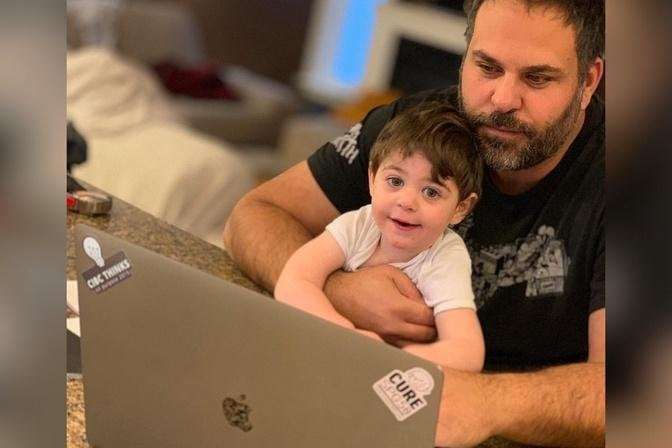
Terry Pirovolakis, an IT director from Toronto, never imagined he would become a medical pioneer. When his third son, Michael, was born in December 2017, everything seemed perfect. But at 6 months, Michael began missing developmental milestones. Months of doctor’s appointments, therapy sessions, and tests led to a devastating diagnosis: spastic paraplegia type 50 (SPG50), an ultra-rare neurodegenerative disease affecting fewer than 100 people worldwide. Doctors told the Pirovolakis family there was no cure and that Michael would become paralyzed and likely quadriplegic in his teenage years, eventually losing the ability to speak and walk.
Faced with this bleak prognosis, Terry made a life-altering decision: If no treatment existed, he would find a cure for his son’s disease himself.
Terry with his son, Michael. (Courtesy of Terry Pirovolakis via CureSPG50)
The diagnosis of SPG50 shattered the Pirovolakis family’s world. Terry recalls the moment the doctors delivered the news: “They said he’d never walk or talk, and would need support for the rest of his life. They told us to just go home and love him — and said he would be paralyzed from the waist down by age 10, and quadriplegic by age 20,” Terry told Fox News.
But Terry couldn’t accept this. He refused to watch his son deteriorate before his eyes, so he vowed to find a solution.
Leaving behind his job as an IT director, Terry began an exhaustive search into gene therapy. He contacted researchers, attended medical conferences, and read hundreds of scientific papers. His journey led him to a team of researchers at the University of Texas Southwestern Medical Center, where Dr. Steven Gray and Dr. Xin Chen were developing a promising gene therapy.
“We then liquidated our life savings, refinanced our home and paid a team at the University of Texas Southwestern Medical Center to create a proof of concept to start Michael's gene therapy,” Terry explained. The gene therapy, based on adeno-associated virus (AAV), would deliver a healthy copy of the AP4M1 gene directly to Michael’s cells, correcting the genetic defect causing SPG50.
Terry with Dr. Steven Gray and Dr. Xin Chen. (Courtesy of Terry Pirovolakis via CureSPG50)
To bring the therapy to life, Terry founded Elpida Therapeutics — named after the Greek word for "hope." His social purpose corporation, run like a nonprofit, focuses on developing treatments not only for Michael but for other children affected by SPG50. However, the road to creating a treatment was fraught with financial and logistical challenges. Producing the therapy cost more than $1 million per dose, and the pharmaceutical industry showed little interest in investing in such a rare disease. “No investor is going to give you money to treat a disease that is not going to make money,” Terry lamented.
With no financial backing from drug companies, Terry and his family turned to the public for support, launching a GoFundMe campaign to raise funds for Michael’s treatment and the ongoing research into SPG50. “We took a lot of financial risks, but we never took any safety risks or shortcuts. Everything that we did was a discussion between me, our FDA Consultant Dr.Balderson, Dr. Gray and the team,” Terry told Global Genes.
Michael with his mother. (Courtesy of Terry Pirovolakis via CureSPG50)
The Clinical Trial That Changed Everything
In March 2022, after years of tireless work, Michael became the first person in the world to receive this life-saving gene therapy at The Hospital for Sick Children (SickKids) in Toronto for SPG50. The treatment involved injecting the healthy gene into Michael’s spinal fluid, allowing it to reach the nerve cells damaged by the disease. This groundbreaking procedure was part of a single-patient clinical trial, which has since been published in Nature Medicine.
The results are too early to fully assess, but Michael’s condition appears to have stabilized, and for the first time, he was able to stand with his heels on the ground — a milestone that had previously seemed impossible. "Thankfully, we had an amazing team at SickKids and a supportive community that lifted us up and gave us the confidence to raise millions of dollars and create a therapy, not only for Michael, but for other children affected by this disease for generations to come," Terry told MedicalXpress.
Although Michael’s treatment is still in its early stages, the therapy’s success has given hope to families around the world. Since then, three other children have received the therapy as part of a Phase 1/2 trial, and all have shown positive signs of improvement. Terry’s determination was supported by a passionate team of doctors and scientists who believed in the cause. As Dr. Gray reflected, “Terry was very convincing as being a good partner on the patient advocacy side and we decided to take the leap”.
A Future for SPG50 and Other Rare Diseases
The success of Michael’s treatment has paved the way for the next phase of clinical trials. With no support from drug firms, Terry is now working to raise funds for a Phase III trial, which will involve treating eight children in the U.S. If the trial is successful, the treatment could be approved by the FDA, allowing more children to access it.
Michael with his siblings. (Courtesy of Terry Pirovolakis via CureSPG50)
Terry’s dream is to see SPG50 added to newborn screening programs, so children can receive the therapy before the disease progresses. "If we can show that it works in all eight children — and we can prove to the FDA that it is making a difference — then the drug will get approved and every child can get it," Terry said.
Terry’s story is one of resilience, hope, and the power of a parent’s love. In a world where rare diseases often receive little attention, his determination to save his son has not only given Michael a fighting chance but also opened the door for other families facing the same terrifying diagnosis. "The technology to cure our children is already here. I hope that someone with immense wealth— and more importantly, the vision and influence — will step in," Terry said.
The Pirovolakis family at Michael's 2nd birthday celebration. (Courtesy of Terry Pirovolakis via CureSPG50)
Their story is the ultimate proof of strength. When faced with impossible circumstances, the Pirovolakis family chose to fight together, holding on to the hope that they could change their son’s future — and in doing so, inspire countless others. “We are hopeful that Michael’s condition has stabilized, though it’s still too early to be certain. However, we are seeing improvements in his cognition, which gives us great hope that this will lead to a better quality of life for him,” Terry told The Bright Story. Michael’s journey is far from over, but with the love and resilience of his family, his future is full of possibility.
MarvinArbit on January 22nd, 2025 at 12:36 UTC »
He didn't create a drug to cure the disorder, he soutght out a team of medical reserchers who were researching a gene therapy which he believed would work for his son. He then financed the further research and trials.
StockingDoubts on January 22nd, 2025 at 11:45 UTC »
Yeah fuck that, this is why you need public funds for research
MissMormie on January 22nd, 2025 at 11:33 UTC »
Slight fix of the title. Dad finds research team that works on something that could cure his son. He then funds them to do the research and actually gets a cure.
Still uplifting news.