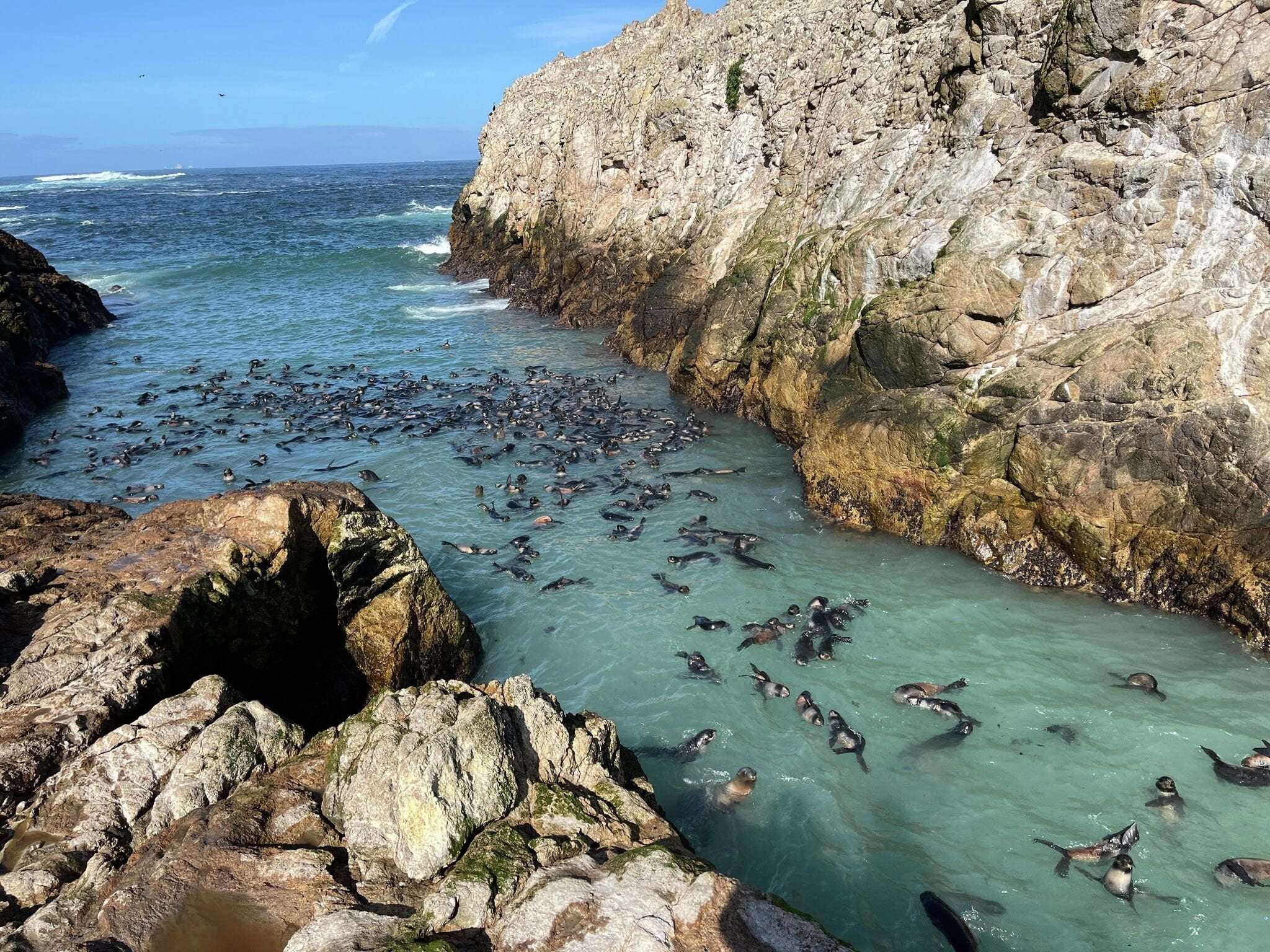
As he peered over a secluded cove off the coast of San Francisco, Gerry McChesney couldn’t believe the scene that was unfolding in front of him.
Fur seal pups — hundreds of them — had taken over the inlet at the Farallon Islands National Wildlife Refuge and were bobbing on the surface of the water in a shiny, blubbery mass, likely hiding from great white sharks as they waited for their mothers to return from the sea to nurse. The sight wasn’t exactly unheard of — island biologists at Point Blue Conservation Science had first noticed the older seal pups using the cove as a covert hideout sometime last year, McChesney, a manager for the refuge, told SFGATE. But he was on the island one day in late October when biologist Jim Tietz delivered the news: The seals were back in full force, and in numbers they had never seen before.
McChesney decided to go take a look for himself.
“I was amazed to see them all piled in there, getting tossed around like they were in a washing machine,” he told SFGATE in an email, adding that he counted 440 in all. “They looked pretty content and like they were having a good ol’ time.”
Advertisement Article continues below this ad
The video McChesney captured was shared by the United States Fish and Wildlife Service on social media earlier this week, garnering thousands of comments on Instagram and Facebook, with users referring to the phenomenon as “seal pup daycare” and “nature’s mosh pit.”
To the biologists, it’s a sign of “a truly remarkable recovery.”
The Farallon Islands host one of just two fur seal rookeries south of Alaska (the other being San Miguel Island in Santa Barbara County) after the species was completely wiped out from the area in the early 19th century. There was extensive seal hunting between about 1810 and 1838, first by sealers from Boston, then the Russian-American Fur Company based out of Fort Ross, McChesney explained. Elephant seal blubber was used for oil, while fur seal pelts were sold to markets in China. In the first few years of widespread hunting, he estimates that over 150,000 fur seals were slaughtered (“The rookery must have been huge,” he noted) and soon, no fur seals could be found at the islands at all.
But large-scale market hunting came to an end by the mid-19th century, he said. In 1911, the United States signed the Northern Fur Seal Treaty, banning the hunting of marine mammals at sea. The Marine Mammal Protection Act, which prohibits killing and disturbing animals including seals, was established in 1972, further aiding in the protection of the species. Two years later, 141 acres of the islands were designated the Farallon Wilderness and were closed to the public in an attempt to mitigate human disturbance so the seals could return and “breed unfettered,” McChesney said. Large breeding colonies still persisted on the Pribilof Islands, Alaska, and the Commander Islands off eastern Siberia, and in 1996, a female fur seal from a recovered colony on the Channel Islands made her way back to the Farallones, giving birth to the first fur seal pup there after more than 150 years of the species’ absence.
Since then, “the Farallon population has been growing rapidly,” McChesney said. Within 15 years, the local population had boomed to 476 individuals, Bay Nature reported in 2018. Initially, they clustered in one area on the west end of the islands — but now, they’re beginning to expand.
“During the breeding season, the rookery is packed with fur seals,” McChesney said. “The waters just off the rookery often have upwards of a few hundred fur seals hanging out to keep cool.”
FILE: A photo of a northern fur seal in Alaska. Brooks Kraft/Corbis via Getty Images
Pupping season runs from June to August, with most of the seals born in July and remaining in the breeding colony for a few months before they are weaned, usually by the end of November. Then, the newly independent animals go out to sea on their own.
Farallon Island biologists from Point Blue Conservation Science have been documenting the population, and this year recorded 2,133 fur seals in total, including 1,276 pups, which McChesney called “the highest pup count yet.”
“Given that the entire colony can’t be seen, this was a minimal count and there were certainly many more,” he noted.
The plethora of seal pups in the cove may have been yet another indication of the species’ ongoing comeback. It’s not uncommon for young individuals to spend time together in groups for several days in the fall while their mothers leave to “fatten up and build milk supplies,” McChesney said. This happens around the same time as shark feeding season at the islands, which falls between September and November. At any moment, dozens of sharks could be lurking in the water just off the rookery, which McChesney called a “prime hunting area.”
FILE - The Farallon Islands off the coast of San Francisco. Kike Calvo/Universal Images Group via Getty
Though Point Blue biologists have never documented white sharks feeding on fur seal pups (they typically go for juvenile northern elephant seals and sea lions) the “threat of shark attacks on the seal pups is certainly there and I’m sure the pups are aware of that,” McChesney said. “The cove where the video was taken provides a secluded spot to swim and play without worrying about the sharks.”
When the mothers return, they find their pups by using a distinctive call. But in the meantime, the pups seem not to mind the hours away in their secret hideout where they can splash and play to their hearts’ content.
NorahGretz on December 24th, 2024 at 20:57 UTC »
New from A24:
"And now they're looking for revenge..."
Alex5331 on December 24th, 2024 at 18:52 UTC »
Yay!
tank911 on December 24th, 2024 at 18:28 UTC »
Good, now leave them the fuck alone!