Invasive ‘murder hornets’ eradicated from the U.S.
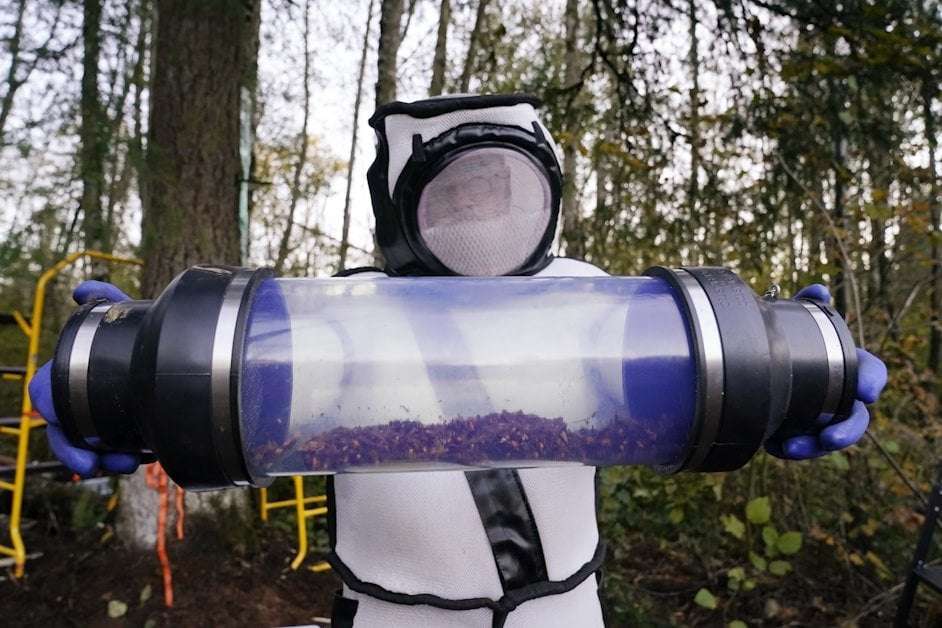
SEATTLE (AP) — The world’s largest hornet, an invasive breed dubbed the “murder hornet” for its dangerous sting and ability to slaughter a honey bee hive in a matter of hours, has been declared eradicated in the U.S., five years after being spotted for the first time in Washington state near the Canadian border. The Washington and U.S. Departments of Agriculture announced the eradication Wednesday, saying there had been no detections of the northern giant hornet in Washington since 2021. The news represented an enormous success that included residents agreeing to place traps on their properties and reporting sightings, as well as researchers capturing a live hornet, attaching a tiny radio tracking tag to it with dental floss, and following it through a forest to a nest in an alder tree. Scientists destroyed the nest just as a number of queens were just beginning to emerge, officials said. “I’ve gotta tell you, as an entomologist — I’ve been doing this for over 25 years now, and it is a rare day when the humans actually get to win one against the insects,” Sven Spichiger, pest program manager of the Washington State Department of Agriculture, told a virtual news conference.
The hornets, which can be 2 inches (5 cm) long and were formerly called Asian giant hornets, gained attention in 2013, when they killed 42 people in China and seriously injured 1,675. In the U.S., around 72 people a year die from bee and hornet stings each year, according to data from the National Institutes of Health. The hornets were first detected in North America in British Columbia, Canada, in August 2019 and confirmed in Washington state in December 2019, when a Whatcom County resident reported a specimen. A beekeeper also reported hives being attacked and turned over specimens in the summer of 2020. The hornets could have traveled to North America in plant pots or shipping containers, experts said. DNA evidence suggested the populations found in British Columbia and Washington were not related and appeared to originate from different countries. There also have been no confirmed reports in British Columbia since 2021, and the nonprofit Invasive Species Centre in Canada has said the hornet is also considered eradicated there. Northern giant hornets pose significant threats to pollinators and native insects. They can wipe out a honey bee hive in as little as 90 minutes, decapitating the bees and then defending the hive as their own, taking the brood to feed their own young. The hornet can sting through most beekeeper suits, deliver nearly seven times the amount of venom as a honey bee, and sting multiple times. At one point the Washington agriculture department ordered special reinforced suits from China.
Positive-Attempt-435 on December 19th, 2024 at 00:04 UTC »
Well that's one thing I can stop worrying about, I guess.
Still got 99 problems a hornet ain't one.
Sabre_One on December 18th, 2024 at 23:58 UTC »
I live in WA, and it was a massive collective effort from not just the WSDA, but the community as well. People set up traps, reported, etc. I hope the community science model we produced here provides a blueprint for future programs attempting to fight invasive species.
mad_soup on December 18th, 2024 at 23:52 UTC »
...for now. Let's hope they don't come back.
That's the stuff nightmares are made of.