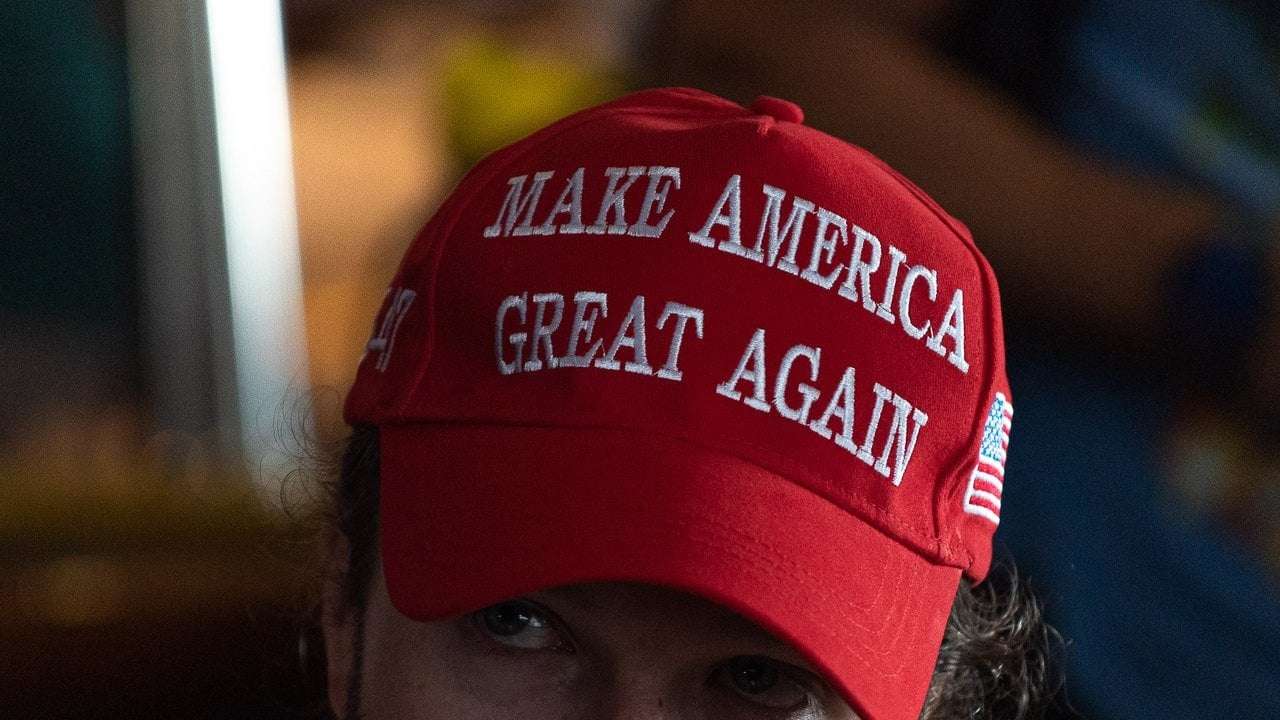
*Subjects asked to use first names only to protect their privacy.
Kate’s parents think she’s going to hell for the abortion she had. They believe vaccines are dangerous and that elite politicians are pedophiles running the world. Though Kate’s parents were always Republicans, something changed around the time president-elect Donald Trump ran for office for the first time. Now she can barely hold a conversation with them anymore. “I just avoid them as much as possible,” she says.
With Donald Trump securing victory in the 2024 election, some Gen Z voters are struggling to deal with their Trump-supporter parents — again. Exit polls so far show that people between age 50 and 64 voted for Trump more than any other age group, at a margin of 56% supporting Trump, who was impeached for inciting an insurrection and found liable for sexual abuse. The disconnect between young people like Kate, 24, and their parents is only widening, leaving families further fractured in the wake of another divided election.
When Kate was growing up, she says, her parents would have described themselves as “fiscal Republicans. They didn’t really care about social issues, trans people, or gay marriage.” In the 2016 primaries, Kate’s dad favored Marco Rubio and thought Trump was a “clown.” But then, seemingly suddenly, her father was drawn into QAnon, a debunked conspiracy theory that posits America is run by Hollywood elites and Democratic politicians who are satanic pedophiles intent on trafficking children and taking over the world.
Kate’s dad started parroting QAnon talking points and politics became a “24/7 topic of conversation," she says. “I’ve come to accept that it’s only getting worse. And the fact that they’ve seen what Trump is capable of and the stuff he said and they’re still fighting for this man — and they would choose to follow him over having a relationship with me — that speaks volumes.” Kate continues, “Especially because I’m an only child, I feel like if I lose my parents, it feels like I’m losing my whole family, essentially.”
The first time Holly, 24, diverged from her parents’ political beliefs was in elementary school, when her teacher held a mock election to mirror the 2008 presidential race. Holly voted for Barack Obama, while her parents voted for Republican nominee John McCain. Her parents now support Trump, which feels contradictory to the way they raised her. Her mother, particularly, always made sure Holly realized how privileged she was and that the family was giving back to charities and being involved in the community. “She’s the person that instilled this deep empathy for others in me,” Holly says, a stark difference from the division Trump espouses. “The reason I believe this way is because of my ability to feel empathy for other groups I’m not even a part of.”
AidenStoat on November 12nd, 2024 at 19:46 UTC »
Every day I am thankful my dad is a Never Trumper. Life long republican who voted Biden and Harris (he voted 3rd party in 2016). Sadly he is the exception it turns out.
sachiprecious on November 12nd, 2024 at 19:13 UTC »
I can relate to this part:
This is what I'm struggling with as well. I've always believed in the importance of empathy and of trying to see things from other people's perspectives, but I've tried to do that with the people in my family (both immediate and extended) who are Trump supporters and I still don't understand. And these family members aren't cultists or Qanon or anything like that. They're not buying MAGA hats. They know Trump is a terrible person and they wish he had a different personality. Yet they voted for him anyway. They gave him a free pass on every awful thing he's done. They rewarded him by giving him the most powerful position in America. They looked at everything Trump has done and they accepted it, and they instead found Harris to be the unacceptable one. It blows my mind.
As the quote above says, there's a fundamental difference in the way Trump supporters and non Trump supporters see the world. This isn't just politics. It's deeper than that. So I feel an odd sense of distance and separation from Trump supporters -- even ones in my family, even ones I live with.
I feel sad about this. I want people who support different candidates to get along. I don't want all this division. But even though I don't want things to be this way, this is how it is. And I'm not sure how it can change.
RickKassidy on November 12nd, 2024 at 18:52 UTC »
Young men voted for Trump at a fairly high level.
Us hippy parents are going to have to start figuring out how to deal with our MAGA children if we aren’t careful.