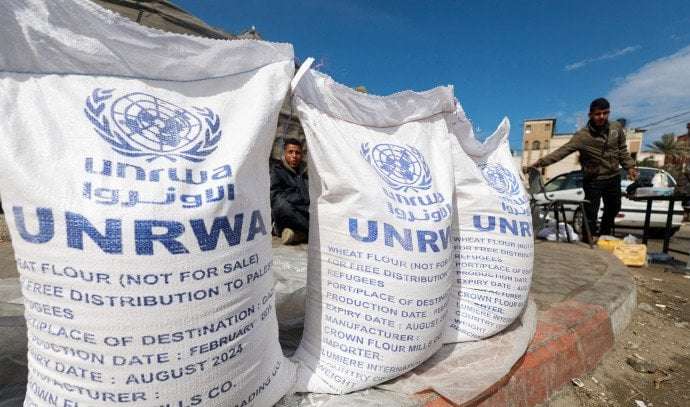
The Knesset plenum approved final voting for two bills aimed at blocking the activity in areas under Israeli control of the UN Relief and Works Agency, which services Palestinian refugees in east Jerusalem, Gaza, and the West Bank.Knesset Foreign Affairs and Defense Committee chairman MK Yuli Edelstein presented both bills in the plenum. According to Edelstein, UNRWA’s operations “eternalized” the issue of Palestinian refugees.
In addition, Edelstein cited the fact that UNRWA employees had participated in, and even served as commanders, in the October 7 Hamas massacre. Edelstein also mentioned incitement in UNRWA school curriculums. According to Edelstein, the time had come to ban the agency from Israel.
Edelstein did not address in his speech who would replace the services UNRWA provides for Palestinians in east Jerusalem, Gaza, and the West Bank.
After the bills passed, Edelstein called the bills “historic” and the “elimination of one of the arms of terror that acted under UN auspices.”
“UNRWA long ago ceased to be a humanitarian aid agency, but in addition to it being an integral supporter of terror and hate, is an agency to eternalize poverty and suffering. The rationale is simple – in order to survive, UNRWA created demand for the product it provides. The circle of horror ended today, they are out!” Edelstein concluded.The two bills are an amalgamation of five bills that were proposed by a large number of members of Knesset, from both the coalition and opposition, indicating broad support. Inside the Knesset building. (credit: MARC ISRAEL SELLEM)
The first bill states that UNRWA will no longer “operate any institution, provide any service, or conduct any activity, whether directly or indirectly,” in Israel.
The second bill states that the treaty between Israel and UNRWA, signed following the Six Day War in 1967, will expire within seven days of the bill passing its final voting in the Knesset plenum; that no Israeli government agencies or representatives may contact UNRWA or a representative of it, beginning three months after the bill passes; that criminal proceedings into UNRWA employees’ involvement in acts of terror will continue; and that Israel’s National Security Council must report to the committee every six months regarding the bill’s implementation.
The first bill passed 92-10, with support from the opposition parties National Unity, Yisrael Beytenu, and Yesh Atid. The Democrats Party abstained. The second bill passed 87-9.
Edelstein told The Jerusalem Post earlier this week that the first bill relates just to east Jerusalem, since the other areas under Israeli control are not officially part of sovereign Israel, and the second broad one cancels the invitation to UNRWA to operate in any area under Israeli control and bars Israeli officials from engaging with it.
One of the bill’s authors, MK Dan Illouz (Likud), said the Jerusalem Ministry had plans in place to take over UNRWA’s responsibilities in east Jerusalem. The ministry said in response to a query that regarding education, the ministry and Jerusalem Municipality are acting to create “alternative education sites in the immediate time range,” and “founding permanent educational institutions in the long run.” Stay updated with the latest news! Subscribe to The Jerusalem Post Newsletter Subscribe Now
Regarding health services, the ministry was acting together with the Health Ministry and Jerusalem Municipality to provide “health solutions” to people who used UNRWA’s services. The ministry was also working with the municipality to “examine the need for alternatives in the field of cleanliness and sanitation.”
The ministry added that it had “filed a request for approval” for funding from the Budget Department, and the Finance Ministry will “convene relevant teams to approve the plans” and set a timetable.
The ministry added, “It should be noted that that process consists of two waves, one directed at the short term and the other at the long term.”
“As the ministry that is responsible for coordinating the government decision to find alternatives to UNRWA, and alongside the Education and Health ministries and the Jerusalem Municipality, we are prepared to provide a solution so that there will not be a single child without an educational framework at the stage of the bill’s implementation, and no person will be left without an alternative health framework.”
In addition, according to Illouz, the three-month interim period was intended to replace UNRWA’s operations in the West Bank and Gaza with other agencies, which will be independently funded and will not be a budgetary burden on Israel. Illouz said that plans were being formulated by the Coordination of Government Activities in the Territories (COGAT) to this effect, but that the information was classified.
Another author of the bills, Likud MK Boaz Bismuth, wrote in a statement following the bill’s passage, “UNRWA is not an agency to aid refugees, it is an aid agency for Hamas!”
Bismuth also mentioned the “chilling” footage of Yonatan Smarno being kidnapped from the Nova music festival on October 7 by what Bismuth said was an UNRWA social worker. Smarno’s father was present in the Knesset visitors’ balcony during the votes.
The Knesset’s Arab MKs, as well as members of the left-wing Democrats party, opposed the bill.
Hadash-Ta’al chairman MK Ayman Odeh responded by pointing out what he said was the “irony” that Israel opposed the fact that the descendants of Palestinian refugees retained their refugee status and claimed a “right of return,” but at the same time maintained that Jewish refugees expelled 2,000 years ago had a “right of return” to the Land of Israel.
MK Ahmad Tibi, also of Hadash-Ta’al, said there were 90,000 UNRWA workers who supplied services to Palestinian refugees, and outlawing all of them was a de-facto attempt to “harm the Palestinian people.”
According to Tibi, UNRWA can be shut down when the Palestinian refugee problem is solved by the formation of a Palestinian state.
The bills were passed into law despite immense international pressure to the contrary. Foreign ministers from Canada, Australia, France, Germany, Japan, South Korea, and the United Kingdom issued a joint statement this week expressing their “grave concern” over the shutdown, particularly in light of the dire humanitarian situation in Gaza due to the war.
“It is crucial that UNRWA and other UN organizations and agencies be fully able to deliver humanitarian aid and their assistance to those who need it most, fulfilling their mandates effectively,” they said.
US State Department spokesperson Matthew Miller warned that passage of the legislation could have consequences for Israel .
"We have made quite clear to the Government of Israel that we are deeply concerned" by its steps against UNRWA, Miller said.
US Secretary of State Antony Blinken raised the issue in a letter he sent to Israel earlier this month, Miller said, as he referenced a document that warned the US council restrict military aid to Israel under the terms of Memorandum 20 unless it took steps to improve the humanitarian crisis in Gaza. The US views UNRWA as a important humanitarian aid provider for the Palestinians.
Blinken "made clear in that letter" that "passage of this legislation could have implications under US law and US policy that remains the case." he said.
The bills also passed despite fears that the international community could seek retribution by taking steps against it at the United Nations. Among the possible political actions at the UN could be a push to strip the Jewish state of voting rights at the General Assembly or the credentials of the Israeli mission to the UN could be stripped.
MK Sharren Haskel (National Unity), who was the initial initiator of the law to end UNRWA's activities in Israel, spoke in the Knesset plenum following its approval in the second and third readings:
"The passing of this law, which I initiated over six years ago, is a milestone and a closing of a circle for me, and I congratulate all my fellow initiators on its approval. Israel has full and absolute right to act against UNRWA, after the failure of the international community. The organization, founded in sin and fundamentally corrupted, lies at the heart of the Israeli-Arab conflict. We will never succeed in moving forward as long as this organization and its definition exist. I call on the countries of the world to abandon their support for the organization and to work with us towards the complete closure of UNRWA."
-Sliced- on October 28th, 2024 at 21:18 UTC »
I think it’s valuable in threads like this to understand the difference between how UNRWA defines refugees vs. how UNHCR does.
UNRWA classifies as refugees Palestinians who were displaced by the 1948 Arab-Israeli war, along with all their descendants. Unlike most other refugee definitions, UNRWA does not have a mechanism to end refugee status through naturalization or integration; instead, refugee status persists until there’s a “durable political solution.”
UNHCR, in contrast, defines a refugee as someone outside their home country with a well-founded fear of persecution due to factors like race, religion, nationality, or political opinion. Its goal is to reduce refugee numbers by finding “durable solutions,” such as citizenship in the host country, resettlement, or safe return. Refugee status under UNHCR does not automatically transfer to descendants unless they meet specific criteria based on the 1951 Refugee Convention’s definition.
These differing goals make UNRWA a unique and politically charged organization. Its existence is reliant on the continuation of the Israeli-Palestinian conflict. Unlike UNHCR, UNRWA is deeply embedded in Palestinian society; most of its staff are Palestinian, and it administers core services like education, healthcare, and social support. This has led to UNRWA doing controversial stuff such as providing educational materials that foster anti-Israel sentiments and refusing to teach the holocaust. In addition, it led it to be deeply integrated with Hamas, and have a many of its members be active combatants.
I think that the right thing to do would be to split UNRWA into two parts:
UNHCR could take over refugee status determination, protection, and advocacy. A Palestinian-run organization could manage essential social services like education and healthcare, and supporting daily life.This way, all the essential services that impact Palestinian daily life—education, healthcare, and social support—would be managed by a Palestinian organization focused on community development rather than by an agency whose primary mandate is refugee support. UNHCR could then focus on refugee protection, resettlement, and the eventual resolution of refugee status, ensuring that Palestinians seeking a path toward citizenship, integration, or resettlement are supported under UNHCR's established framework (e.g. Palestinian living in Lebanon while Lebanon is refusing to provide them citizenship, who are neglected right now).
Edit: Adding a little bit more information about the perverse incentives this situation creates.
The biggest problem with the current situation is that it instills an inter-generational desire of Palestinians to reverse the outcome of the 1948 war, rather than moving forward and building a better future for themselves. Palestinians in Lebanon are a prime example: most remain stateless, and few in the world seem to care about their situation. If Lebanon were to offer them citizenship, it might even be seen as undermining the Palestinian cause, as it could encourage them to integrate into Lebanese society rather than return as Palestinians. As a result, these people are used as political tools rather than being afforded the same rights as other refugees. This mindset is also common among Palestinians in the West Bank and Gaza, most view themselves as entitled to the entire land "from the river to the sea," which complicates any prospects for a peaceful resolution.
DroneMaster2000 on October 28th, 2024 at 20:25 UTC »
SS: The Knesset passed two bills to ban UNRWA from operating in Israel-controlled areas, citing its alleged role in perpetuating the Palestinian refugee issue and involvement in terror activities.
MK Yuli Edelstein argued UNRWA supports terrorism and dependency, claiming its end will help resolve the conflict. The bills terminate UNRWA’s 1967 treaty with Israel, bar government contact with the agency, and mandate criminal proceedings against UNRWA employees linked to terrorism.
Some limited context:
Askar - UNRWA: Cradle of Killers
Another UNRWA Teacher in Gaza Held an Israeli in Captivity for Hamas
IDF uncovers top secret Hamas data center right under UNRWA’s Gaza Strip HQ
Terror Tunnel Discovered Under UNRWA Schools as Hamas Continues Military Buildup
IDF says it killed Hamas terrorist who led massacre at Re’im shelter – an UNRWA worker
The UNRWA Refugee Controversy Explained
TheJacques on October 28th, 2024 at 20:25 UTC »
Most companies or executives get axed after 9 to 18 months for failed performance...imagine 75 years of failed performance!