When a young Yazidi woman in a pink hijab posted a TikTok video from Gaza last year, her face masked by a crying emoji, saying she was there “against my wish” and pleading for help, she had no idea that she would spark a military operation involving undercover agents and Israeli drones.
Now an Israeli brigadier-general and a Moroccan-Canadian dealer in vintage cars dubbed “the Jewish Schindler” have detailed for the first time the dramatic rescue of the former sex slave Fawzia Amin Seydou, 21, from one of the world’s deadliest war zones earlier this month.
Seydou’s escape involved a hasty flight to the border and a diplomatic wrangle to get her home to Iraq. But while it resulted in a tearful reunion with her mother, it has torn her away from her two young children, who remained behind.
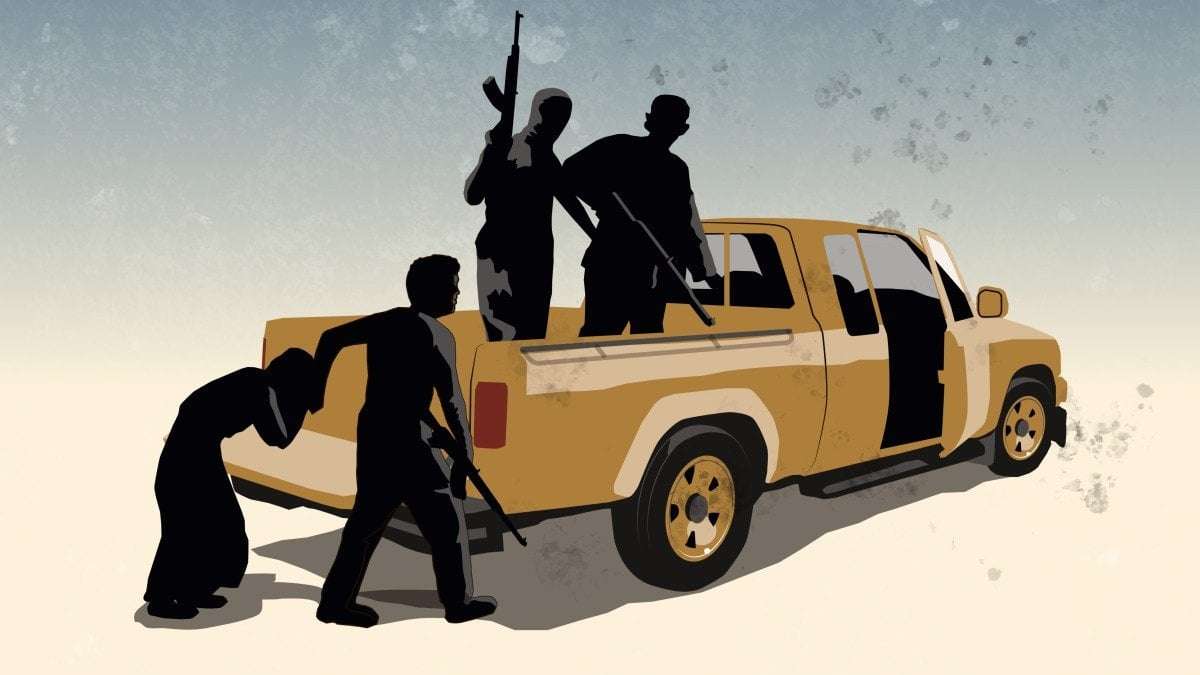
Seydou was just 11 when she was kidnapped by Islamic State fighters who stormed her home area of Sinjar in northern Iraq in August 2014, killing men and abducting thousands of young women and girls.
Fawzia Amin Seydou in the care of the Iraqi authorities earlier this month after her journey home from Gaza via Israel and Jordan. She was reunited with her mother and two brothers later that evening MINISTRY OF FOREIGN AFFAIRS OF THE REPUBLIC OF IRAQ
Taken to a slave market in Mosul, she was traded between different Isis fighters and repeatedly raped. After a year she was moved to the Syrian city of Raqqa where she was married off to her third captor, a 24-year-old Palestinian from Gaza who she says also belonged to Hamas.
“He told me that I had to sleep with him,” she said in an interview with Kurdish TV channel Rudaw. “On the third day, he went to a pharmacy and bought a drug that numbs part of the body. He gave me the drug and I cried.”
The following year she gave birth to a boy, then some time later a daughter.
In late 2018 her captor was killed in fighting for the Islamic State, which was driven out of its last stronghold by Kurdish forces backed by a US-led coalition. Seydou was transferred to Al-Hawl, a grim camp for Isis wives in the desert of northeast Syria where as many as 100 Yazidi women still remain.
Her captor’s brother was also in Isis and in 2020 he arranged to get her and the children out through Turkey to Egypt and through tunnels to Gaza. Desperate to escape the camp, and thinking her own family dead, she agreed.
But once in Rafah she says the family were so abusive, forcing her to clean and cook and regularly beating her, that at one point she took an overdose, ending up in hospital.
Eventually, last September, she made the TikTok video asking someone to contact Nadia Murad, the Nobel peace prizewinning Yazidi activist. “HELP me,” she pleaded. “I’m really tired, it’s not just their men, their women and children also harass me … They might assault me, KILL me … it’s really overwhelming.”
It was picked up by a Kurdish TV channel, which interviewed her. The story was seen by her mother who had long assumed her daughter was dead.
Steve Maman at a meeting of The Global Women’s Coalition Against Gender-Based Violence as a Weapon of War at the Knesset, in Jerusalem, in May YONATAN SINDEL/FLASH90
As Israeli forces moved into Gaza in response to the October 7 attack by Hamas, her family made contact with Steve Maman, a Moroccan-born Canadian businessman who makes his money from selling vintage cars to collectors. Known as “the Jewish Schindler”, he had rescued 140 Yazidi women and girls from Isis captivity.
“Rescuing Fawzia was the hardest, most complex of any rescue,” he said, “like a Holocaust-era kind of thing. The geopolitical situation really complicated things.”
After exploring ways to smuggle her out of Gaza, Maman began to lobby the Iraqi government with whom he has good relations through his previous rescue missions as well as Israeli, American and Jordanian officials. He spoke in the Knesset, the Israeli parliament, and persuaded the Iraqi consulate in Jordan to issue a “laissez-passer” travel document in absentia, using a photo of Seydou taken from one of their Skype conversations. This in itself was a remarkable step given that Israel and Iraq have no diplomatic relations.
But as the months went by, Seydou was getting more and more desperate. “You’d think countries might put aside their differences to help a young girl taken at 11 and who’s hurting. But the beautiful thing is that in the end, they did,” said Maman.
In September a senior Israel Defence Forces (IDF) officer, Brigadier-General Elad Goren was appointed to a new post of “head of humanitarian-civil efforts in Gaza”.
Elad Goren, an IDF officer, was instrumental in the rescue IDF
“When I learned about Fawzia’s case I was shocked,” he told The Sunday Times in an exclusive interview. “Initially I couldn’t believe it was a real story. If we had an opportunity to help and try to give her a better future, we should do it.”
By then, he said, her captor’s brother had been killed in an airstrike and she had managed to escape with the family to north Gaza, provided with money and a phone by Maman.
The brigadier’s team made contact with her and studied three options for extracting her. The first, getting her to make her own way to the Kerem Shalom crossing, was, he said, “fraught with danger and risked losing contact with her”.
The second, sending in IDF soldiers, was rejected. Instead he settled on “sending a trusted person we know from Gaza to secretly pick her up”.
Early on Tuesday, October 1, Fawzia was told to be ready in six hours. As the vehicle collected her, Goren monitored the whole process from a control room. “We sent drones overhead to escort the car from the air and directed its route to make sure they bypassed roads where Hamas and criminals were operating.”
It took about 90 minutes for her to be brought to the crossing where his team and an ambulance were waiting.
“It was a major operation but it didn’t matter how many resources we invested as we have a Hebrew saying, ‘If we save one life, it’s as if we save the whole world’,” said Goren. “I’m happy she’s safe and if there are other such cases in Gaza I encourage them to contact us.”
Asked about the thousands of Palestinian women and children being killed and wounded in Gaza in Israeli airstrikes, including a school hit just hours before we spoke, he replied: “There is a difference between Palestinians and foreigners and between locals and someone sold to Hamas.”
“We have evacuated more than 4,000 Palestinians who need medical treatment,” he added.
Once over the crossing, Seydou was driven by US embassy officials to the Allenby Bridge crossing with Jordan where she was handed to the Iraqi consulate. The next morning she was flown to Baghdad then north to Erbil where she was debriefed, before being driven to Sinjar and reunited with her mother and two brothers.
It should have been a joyful end to a remarkable journey. But her father had died of a heart attack just two months ago and the family home in Gerasik had been destroyed by Isis.
“It won’t be easy,” warned Ahmed Qasim of Nadia’s Initiative, the organisation set up by Nadia Murad, who visited her after her return. “The family is very poor and Fawzia has spent half her life in captivity and quite traumatised by what she went through.”
That’s not all. Seydou had been forced to leave behind her two young children in Gaza, something she says she now bitterly regrets.
“She loved those children,” said Maman. “Now she is free, she’s thinking about them and feeling why couldn’t she have brought them too.
“But they are Hamas children. There’s no way they would have let her take them … Nor would the Yazidis have accepted her with them.”
Sadly, although the Yazidis now welcome back women abducted by Isis, they refuse their children who they see as Muslims. Seydou’s own father had warned her on the phone “if you bring the children back, you won’t be accepted”.
“Someone held that long has Stockholm syndrome,” added Maman. “I know she is questioning a lot at the moment but I hope she is strong enough to overcome the emotions.”
Catoutofbag46 on October 14th, 2024 at 20:06 UTC »
There is an entire unit in the SDF made of Yazidi women. One of them was interviewed and she said "we don't prisoners. We kill every ISIS member we come across"
GoodLeftUndone on October 14th, 2024 at 19:44 UTC »
I’m kind of bothered by the claim she has Stockholm? She specifically reached out and pleaded for help listing the abuse of the entire family as reasoning? That seems the complete opposite of Stockholm syndrome? Unless there’s much deeper, nuanced forms and I’m an idiot. It seems extremely disrespectful to what she went through to claim she sympathized with her captors.
CupidStunt13 on October 14th, 2024 at 18:18 UTC »
What this woman went through is horrifying, but it is not out of the ordinary for what Yazidi women have gone through over the past decade or more.
https://www.npr.org/series/735498202/life-after-isis-the-struggle-and-survival-of-yazidis
https://www.pbs.org/wgbh/frontline/article/yazidis-decade-after-isis-genocidal-campaign/
https://en.wikipedia.org/wiki/Yazidi_genocide#Violence_against_Yazidi_women_and_girls