CERN to expel 500 Russian scientists from November 30
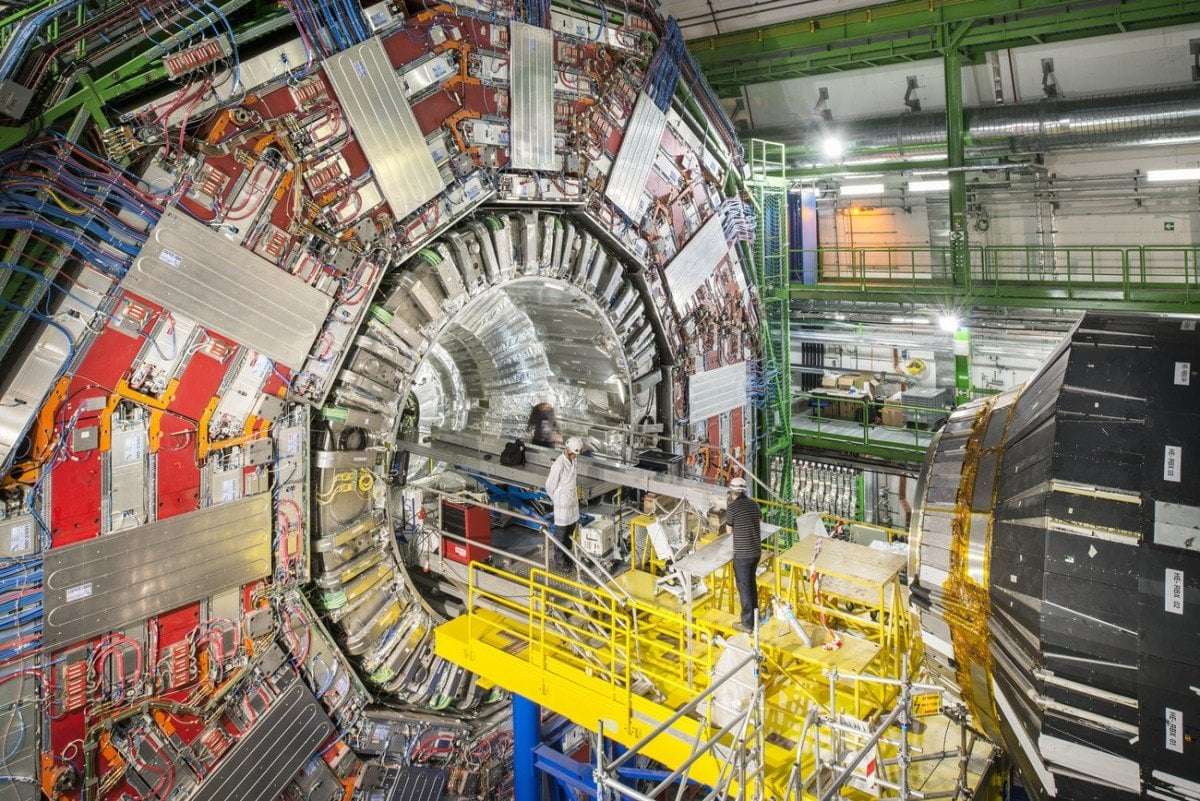
A view of one of the experiments of the Large Hadron Collider at CERN, the European Organization for Nuclear Research near Geneva. Keystone / Christian Beutler
Listen to the article Listening the article Toggle language selector Select your language Close English (US)
English (British) Generated with artificial intelligence. Close Share
The European Organization for Nuclear Research (CERN) is to cut cooperation with 500 scientists affiliated with Russian institutions from November 30. Around 100 have joined non-Russian institutes in order to continue their physics research work with Europe’s particle-physics laboratory.
Keystone-SDA Other languages: 2 EN original Español es El CERN expulsará a 500 científicos rusos a partir del 30 de noviembre Read more: El CERN expulsará a 500 científicos rusos a partir del 30 de noviembre
Русский ru Ученые из России не смогут сотрудничать с ЦЕРН Read more: Ученые из России не смогут сотрудничать с ЦЕРН
+ Get the most important news from Switzerland in your inbox
In response to Russia’s invasion of Ukraine, the CERN Council decided in June 2022 to end cooperation with Russia and its ally Belarus. This measure will enter into force on November 30 for Moscow and has already been in force since June 27 for Belarus. The two countries are linked to CERN by agreements lasting five years, and the organisation has decided to terminate them when they expire.
Around 500 scientists affiliated to Russian laboratories will no longer be able to collaborate with CERN, as has already been the case for a dozen Belarusian researchers, Arnaud Marsollier, head of the organisation’s press relations, told the Keystone-ATS new agency on Sunday, confirming an earlier report in the journal Nature. Very few of the Russian and Belarusian scientists are based in Geneva, where CERN is located.
Removing Russia from CERN ‘helps Putin’, scientists fear
The exclusion of Russia has resulted in a loss of CHF40 million for the financing of the upgrading of the Large Hadron Collider (LHC) at CERN, which will allow the number of particle collisions to be multiplied by three from 2029. Russian agencies and institutions also contributed 4.5% of the LHC’s experimental budget, a sum that is covered by other members.
However, Russian scientists will be able to continue to work at CERN if they are affiliated with non-Russian institutes. The Council resolution states that its measures “concern relations between CERN and the Russian and (Belarusian) institutes and do not affect relations with scientists of Russian nationality affiliated with other institutes”.
+ CERN has not completely cut ties with Russia
The employees of the Joint Institute for Nuclear Research (JINR), located in Doubna, 120 kilometres north of Moscow, were not excluded from expulsion from CERN, which has provoked anger in Kyiv. In 1993, due to the war and a United Nations embargo, CERN suspended all co-operation, exchanges and visits with the Republic of Yugoslavia.
How we work This news story has been written and carefully fact-checked by an external editorial team. At SWI swissinfo.ch we select the most relevant news for an international audience and use automatic translation tools such as DeepL to translate it into English. Providing you with automatically translated news gives us the time to write more in-depth articles. If you want to know more about how we work, have a look here, if you want to learn more about how we use technology, click here, and if you have feedback on this news story please write to [email protected].
Deguilded on September 30th, 2024 at 11:45 UTC »
As long as a Japanese scientist doesn't take his daughter's time travel paper and defect, it's all good.
oripash on September 30th, 2024 at 10:01 UTC »
Can we get the IMF to follow suit with 500 Russian economists?
BezugssystemCH1903 on September 30th, 2024 at 09:59 UTC »
Article: