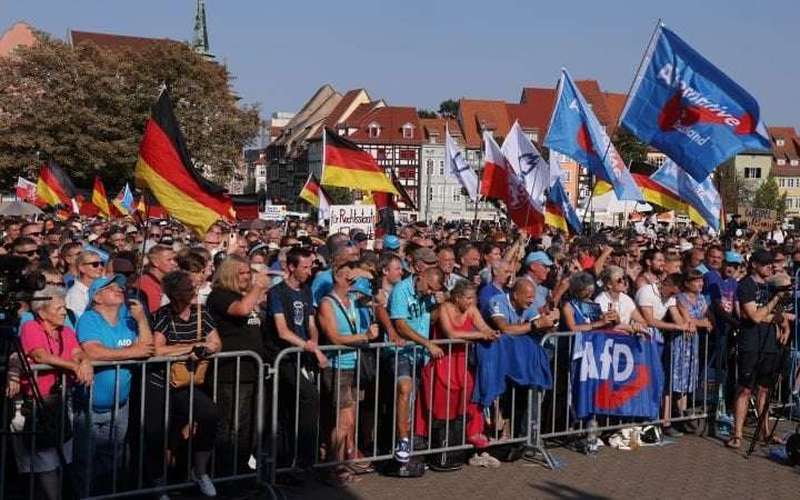
The Alternative for Germany (AfD) has become the first far-right party to win a state election in Germany since the Nazi era, dealing a crushing blow to Chancellor Olaf Scholz’s government with only a year to go before the next federal election.
If federal elections were held now, recent polls show the AfD could become the second-largest group in the Bundestag, with the SDP trailing in third.
Scholz described the results as “bitter” and, calling on the European principle of the “cordon sanitaire,” urged mainstream parties in Thuringia and Saxony to exclude the AfD from any state governing coalitions.
“All democratic parties are now called upon to form stable governments without right-wing extremists,” Scholz said in a statement.
Alice Weidel, co-leader of the AfD, speaks during the final election campaign rally in Erfurt, Germany, on Saturday.
Mainstream parties perform less well in the east, creating space for anti-establishment parties like the AfD and political entrepreneurs like Wagenknecht.
That message is taking root in the fertile ground of Germany’s east, where voters told CNN they felt neglected by traditional parties. »