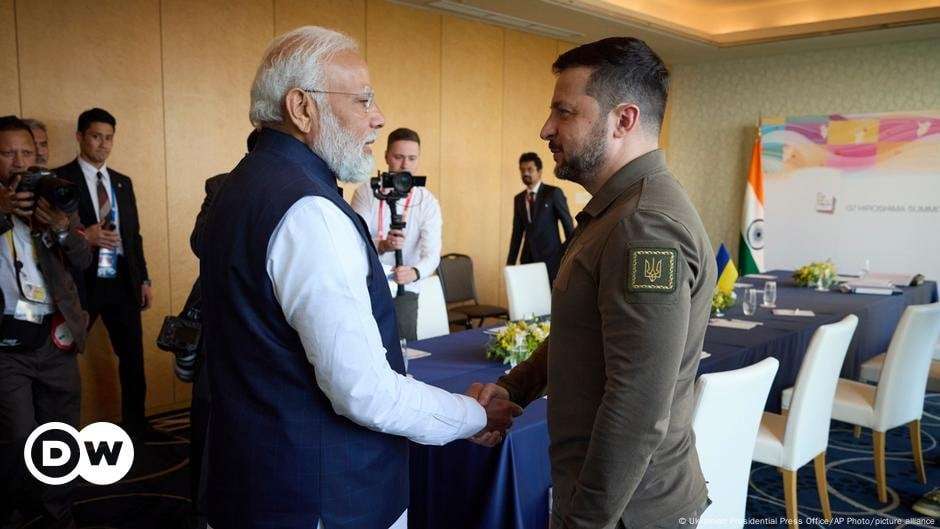
Narendra Modi will travel to Ukraine, becoming the first Indian leader to visit the war-torn country in some 30 years. But Modi has good reasons to try to placate Kyiv and its Western allies.
Kyiv is due to welcome Indian Prime Minister Narendra Modi on August 23, on the eve of Ukrainian Independence Day, and just over a month after Modi visited Moscow.
His visit is sure to envoke mixed feelings among his Ukrainian hosts. India has persevered in maintaining close ties to Russia despite the full-scale invasion of Ukraine in February 2022, at the cost of significant irritation to Kyiv and its allies.
While Modi has called for peace, he has also refused to directly hold the Kremlin responsible for the war.
This was also illustrated during Modi's trip to Russia in July and his meeting with President Vladimir Putin, which coincided with Moscow's deadly attack on a Ukrainian children's hospital.
The Indian prime minister responded with a carefully worded comment.
"When innocent children are killed, the heart bleeds and that pain is very terrifying," Modi said at the time.
First visit of Indian leader to Ukraine in decades
In turn, Ukraine's President Volodymyr Zelenskyy described Modi's visit to Russia as a "disappointment."
"It is a huge disappointment and a devastating blow to peace efforts to see the leader of the world's largest democracy hug the world's most bloody criminal in Moscow on such a day," Zelenskyy wrote online.
Modi embraced Putin during his trip to Russia in July Image: Gavriil Grigorov/Sputnik/Kremlin Pool Photo via AP/picture alliance
Now, Modi is set to make his first visit to Ukraine since the war began in February 2022, and the first visit by an Indian leader to Ukraine for about 30 years.
"India has substantive and independent ties with both Russia and Ukraine and these partnerships stand on their own," Tanmaya Lal, Secretary (West) at the Indian Ministry of External Affairs (MEA) told reporters during a media briefing on Monday.
Experts say that this visit is a balancing act for India, which also gives New Delhi a chance to urge peace negotiations.
But Indian diplomacy has to maintain a difficult balance.
"Russia is a long-term traditional ally and Ukraine also has had very friendly relations with India. It is a difficult task to manage this, especially because Ukraine has received strong support from the West, with which India also has good relations," Rajiv Bhatia, former Indian ambassador, and a distinguished fellow at the Gateway House think tank, told DW.
"India wants to expand, consolidate and maintain its ties with Russia," he said, adding that New Delhi was not concerned that the Kyiv visit could jeopardize India's relations with Moscow.
Military, trade and diplomatic ties between Russia and India already run deep.
India purchases over 40% of its oil and 60% of its armaments from Russia, and also imports significant amounts of coal, fertilizer, vegetable oil and precious metals.
India's economy reaps benefits from Russian oil imports To view this video please enable JavaScript, and consider upgrading to a web browser that supports HTML5 video
The fact that Russia is being shunned by the West over the Ukraine invasion is working in India's favor, as it motivates Moscow to pursue even closer ties. Also, New Delhi is wary that alienating Moscow could push Russia closer to China, which is India's major rival in Asia.
Complicating the geopolitical calculation even further, the US and other Western countries are irritated by Modi's Russia-friendly stance and by his meeting with Putin.
However, the West also doesn't want India to lose this influence in Moscow, as India could serve as a counterbalance to China when trying to sway the Kremlin.
What will Modi do in Kyiv?
"India will try to project itself as a peacemaker and engage in humanitarian assistance," Amit Julka, an assistant professor of International Relations at Ashoka University, told DW.
"Despite India's closeness to the US, there are undercurrents of suspicion. The Ukraine visit will also serve as damage control in terms of the optics. While it enjoys close ties with Russia, India does not want to alienate the West," Julka said.
India's Foreign Ministry said that New Delhi would not unveil a peace plan in Kyiv, but India was ready to support the negotiation of a peace settlement.
What else is on the agenda?
Apart from Russia's war on Ukraine, there are several other items on that Modi will likely discuss with Ukraine's President Volodymyr Zelenskyy.
Ukraine war: The plight of Indians trapped in Russian army To view this video please enable JavaScript, and consider upgrading to a web browser that supports HTML5 video
"Defense and economic cooperation, and the role of India in the eventual rebuilding of post-war Ukraine will also be discussed," said former ambassador Bhatia.
"Modi is also likely to express gratitude towards the Ukrainian government for their help in evacuating Indian students after the war broke out," he added.
Before the full-scale war in Ukraine, India had about 19,000 students enrolled in Ukrainian universities. Following the Russian invasion in February 2022, India, Ukraine and Poland worked together to evacuate most of them in a push dubbed "Operation Ganga."
Before you leave: Every Friday, the DW Asia newsletter delivers compelling articles and videos from around the continent right to your inbox. Subscribe below.
Sam1515024 on August 21st, 2024 at 10:01 UTC »
While I don’t expect much from this visit, the fanfare and media attention it is receiving means that more indians will be targeted/labelled for buying oil and funding wars bla bla etc.
Also recent coup in bangladesh might be signal for india to change their current stance, now which side will they lean on? That remains to seen
di11deux on August 21st, 2024 at 06:16 UTC »
The answer is simple - India has always played both sides of a conflict it’s not directly entangled with. They still have extensive dependence on the Russian MIC and rely on Russian energy imports. They also see positive relations with Russia as a necessary hedge against China, which is a more acute and persistent threat to them than Russia is.
Simultaneously, they also don’t want to be seen as condoning imperial aggression, and will throw Ukraine a diplomatic fig leaf. Ukraine gains very little though without India explicitly cutting ties with Russia, so this move is to show western observers that India will be independent, even if their actions still show they need Russia around.
So this is a show visit. That doesn’t mean it’s worthless, but that’s fundamentally what it is.
donutloop on August 21st, 2024 at 05:04 UTC »
Submission Statement:
The article "Why is India's PM Modi visiting Ukraine after Russia?" provides a comprehensive analysis of Indian Prime Minister Narendra Modi's upcoming visit to Ukraine, marking the first visit by an Indian leader to the war-torn country in approximately 30 years. This visit comes at a crucial time, as India attempts to maintain its delicate balance in international diplomacy amidst ongoing tensions between Russia and Ukraine. The article explores the complexities of India's relationships with both nations, highlighting the strategic importance of Modi's visit to Kyiv in light of India's long-standing ties with Russia and its increasing engagement with Western powers. Through expert insights and geopolitical context, the article underscores India's pursuit of a nuanced foreign policy aimed at promoting peace while safeguarding its national interests.