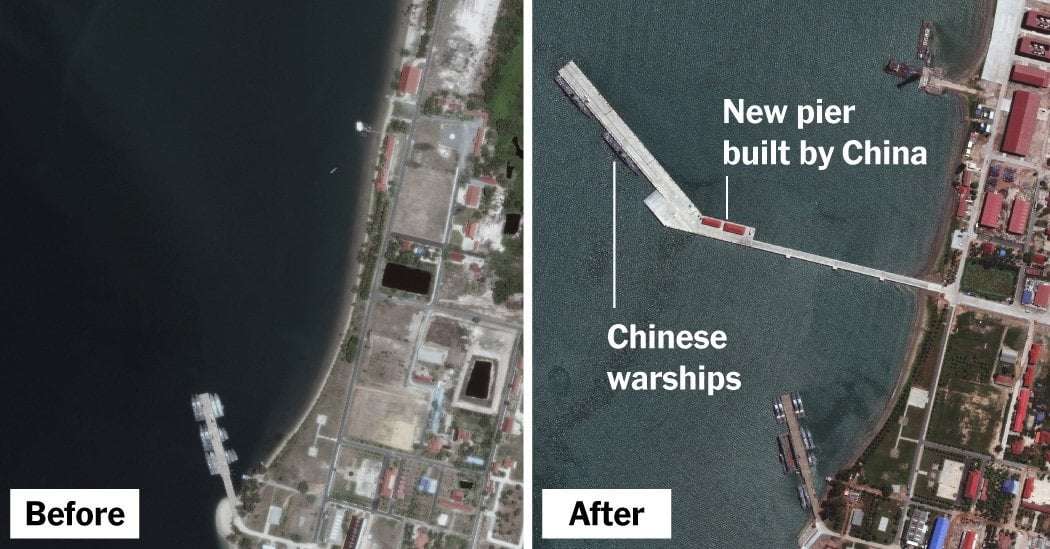
Security gate Chinese-funded buildup CAMBODIA Chinese warship CAMBODIA CAMBODIA Dry dock and other repair facilities Before After China insists it is not building a naval base in Cambodia. Cambodia says the same. But this aircraft carrier-ready pier suggests otherwise. As does this enormous drydock. Perched near a major sea route, they appear tailor-made to advance China’s naval ambitions.
The Chinese Base That Isn’t There New facilities and the months-long presence of Chinese warships show Beijing’s growing global influence.
In 2020, something curious happened at Cambodia’s Ream military base, on the Gulf of Thailand.
Not long after submitting — and then abruptly withdrawing — a request for the U.S. Defense Department to refurbish parts of the base, Cambodian officials proceeded to demolish the American-funded buildings that were already there, some only four years old.
Then the Chinese got to work.
Since December, two Chinese warships have docked nearly every day at the rapidly expanding port. And the work taking place at Ream is in keeping with a Chinese building spree that ranges from near the Red Sea to the South China Sea.
The Chinese military presence near one of the world’s most vital sea lanes raises fundamental questions about Beijing’s ambitions. While the American constellation of military bases remains by far the largest in the world, a resurgent China is bringing countries like Cambodia into its orbit.
“The potential for a permanent Chinese military presence in Cambodia raises significant geopolitical concerns,” said Sophal Ear, a Cambodian-American political scientist at the Thunderbird School of Global Management at Arizona State University. “It could prompt strategic adjustments from the U.S. and heighten global perceptions of Chinese militarization.”
Cambodian and Chinese flags at joint military drills in Cambodia last month. Agence France-Presse — Getty Images
On Dec. 3, 2023, Cambodia’s defense minister announced that two Chinese Navy corvettes were visiting Ream for a joint military exercise. Satellite images show that the warships had arrived two days earlier. They have stayed in the vicinity ever since.
The corvettes are the only ships that have docked at the new Chinese-built pier at Ream, which can accommodate ships far larger than any in Cambodia’s fleet. Cambodia’s own smaller corvettes dock at a much more modest pier to the south.
Two Chinese warships have docked at Ream for more than seven months Dec. 3, 2023 Dec. 14 Dec. 29 Jan. 16, 2024 Jan. 30 Feb. 7 Feb. 18 Feb. 24 March 3 March 24 April 5 April 17 April 29 May 8 May 18 June 6 June 14 July 2 Source: Satellite images by Planet Labs
Over the past few years, American officials and Japanese naval vessels have also tried to visit Ream. They were denied full access.
“We are clear eyed about the People’s Republic of China’s efforts to establish overseas military bases, including at Ream,” said John Supple, a Pentagon spokesman. “We’re particularly concerned about the People’s Republic of China’s lack of transparency around its intentions and the terms it negotiates, because countries should be free to make sovereign choices that support their interests and regional security.”
The Cambodians deny any greater Chinese intent.
When Lloyd J. Austin III, the U.S. secretary of defense, traveled to Cambodia in early June, he was told by his counterparts there that China was simply helping Cambodia modernize its military, not building a base for itself.
“The Ream military base is Cambodia’s, not the military base of any country,” Mey Dina, the commander of the base, told The New York Times. “It is not right to say that the base is controlled by China.”
While the construction at Ream is still underway, no foreign vessels will be allowed to dock there, Mr. Mey Dina said. The foreign vessels that have been docked there for more than half a year — the Chinese corvettes — were for “training only,” he said.
China’s leader, Xi Jinping, has articulated a grand vision for his growing superpower. Chief among his military goals: a blue-water navy that can project Beijing’s might far from China’s shores.
Today, China boasts the world’s largest navy in terms of the number of vessels. And it has added aircraft carriers to its fleet.
But navies of this size and scope, operating thousands of miles from home, need access to bases abroad.
In 2017, after years of evasiveness about what was being built, China completed its first base on foreign soil, in Djibouti, in the Horn of Africa.
The pier at Ream appears similar to one at China’s Djibouti Naval Base 1100 ft Long pier Perimeter fence Fuel storage Aircraft hangars Red Sea Basketball courts YEMEN Djibouti, Djibouti ETHIOPIA Perimeter fence 1100 ft Fuel storage Similar style of pier Basketball courts Dry dock THAILAND VIET- NAM Ream, Cambodia Malacca Strait 750 feet Sources: BlackSky; Center for Strategic and International Studies (C.S.I.S.); satellite images by Planet Labs on May 27 and May 8, 2024.
That same year, China put finishing touches on a far more startling project in disputed waters in the South China Sea.
Churning up coral and sand from the ocean floor, state-owned dredgers created military installations on what had once been placid atolls called the Spratlys. An international tribunal has ruled that some of those specks of land are not Chinese territory.
The same kind of state-owned dredgers are now operating in Ream. Out of reclaimed land, they have created a wharf and dry dock, each of which far surpasses the needs of the Cambodian fleet.
Still, unlike the installations at the Spratlys, Ream does not appear to have building sites reserved for missile launchers or fighter jet hangars. Ream may be primarily intended as a resupply station for the Chinese navy, according to satellite analysts.
China’s military footprint abroad is small but growing Mischief Reef South China Sea Completed 2018 Djibouti Subi Reef Africa, 2017 South China Sea, 2018 Fiery Cross Reef Ream South China Sea, 2018 Southeast Asia Under Construction 2 miles Djibouti Mischief Reef Africa, Completed 2017 South China Sea, 2018 Ream Fiery Cross Reef Subi Reef South China Sea, 2018 South China Sea, 2018 Southeast Asia, Under construction 1 mile Mischief Reef South China Sea, 2018 Djibouti Ream Africa, Completed 2017 Southeast Asia, Under construction Fiery Cross Reef Subi Reef South China Sea, 2018 South China Sea, 2018 1 mile Sources: C.S.I.S.; Congressional Research Service; satellite images by Planet Labs. Note: Completion year based on first report of personnel deployment or training exercise.
“Ream is more like China playing roulette as it looks for ports for the blue water navy that Xi Jinping wants,” said Gregory B. Poling, director of the Asia Maritime Transparency Initiative at the Center for Strategic and International Studies. “I don’t think any Chinese planner looked at all the possible locations around the world and said, ‘Ream is the one we need.’ It’s more that Ream is one of the only ones on offer because China has no real allies and few friends.”
Even as the dredgers were working overtime at the Spratlys, Mr. Xi stood at the White House and swatted away fears that China’s new islands — which now bristle with fighter jet-ready runways, radar domes and warehouses made for missiles — were for military purposes. Chinese officials said they would be havens for tourism.
China’s base building has depended on state-owned companies, which are legally obligated to pursue the country’s national security interests, to make the initial forays. Chinese officials are blunt about the strategy: “First civilian, then military,” is how they put it.
China has expanded its commercial influence across the world's seas ASIA EUROPE NORTH AMERICA Ports financed by China CHINA AFRICA Djibouti Ream SOUTH AMERICA SRI LANKA may host the next base, say experts AUSTRALIA Ports financed by China ASIA EUROPE CHINA AFRICA Djibouti Ream SRI LANKA may host the next base, say experts AUSTRALIA Source: AidData Note: Data shows ports partially or fully financed by Chinese state-owned companies via loans and grants made in 2000–2021 for implementation 2000–2023. Map shows only projects over $10 Million.
Establishing a commercial beachhead is easier in countries where China already holds economic sway.
In recent years, Cambodia has steadily marched into China’s arms. Its longtime leader, Hun Sen, used to excoriate the United States for linking its aid and investment to improvements in the country’s human rights record.
Now, Cambodia is led by Mr. Hun Sen’s son, Hun Manet, who, although a graduate of the United States Military Academy, has shown little inclination so far to recalibrate from his father’s pro-China bent.
Ream is 80 percent finished, according to its commander, Mr. Mey Dina. Military analysts expect that the base will be complete by the end of the year.
Not far away, a Chinese company has carved out of once-protected jungle a runway long enough to accommodate bombers, which Cambodia does not have. The company says the airfield is largely intended for Chinese holiday-goers.
That is reminiscent of the innocent explanations offered for the Chinese construction in the Spratlys and Djibouti, said Mr. Ear, the political scientist.
“China downplays or misrepresents the military nature of its overseas installations,” he said. “Despite Cambodia’s denials, the lack of transparency and the close relationship between Cambodia and China suggest the possibility that Ream could follow this familiar playbook.”
Sprintzer on July 18th, 2024 at 15:09 UTC »
I expect more China to construct several more overseas Naval/air bases in the coming years. It seems like they will only have success in building these somewhere in Africa.
The US holds too much influence in the Pacific and South America.
Other than bases in the South China Sea / near Taiwan, I think priority #1 for China is to establish bases that can be used to secure their trade lines, especially to the Middle East for oil. They are at risk of a blockade if a war were to start.
telephonecompany on July 18th, 2024 at 09:08 UTC »
SS: In this NYT article, Agnes Chang and Hannah Beech uncover the intricate dynamics of China's burgeoning naval presence at Cambodia's Ream military base, revealing Beijing's expanding global influence despite denials from both nations. Since 2020, following Cambodia's curious demolition of American-funded facilities, Chinese warships have docked regularly, a sign of Beijing’s strategic ambitions.
Sophal Ear, a Cambodian-American political scientist, succinctly states, "The potential for a permanent Chinese military presence in Cambodia raises significant geopolitical concerns." Adding to the intrigue, Gregory B. Poling from the Asia Maritime Transparency Initiative points out, “Ream is more like China playing roulette as it looks for ports for the blue water navy that Xi Jinping wants.”
This development is part of China's broader strategy of establishing commercial beachheads, leveraging state-owned companies for initial economic sway before military intentions surface. Despite claims of benign intentions, the regular docking of Chinese corvettes and the construction of facilities far exceeding Cambodia’s needs suggest otherwise. Commander Mey Dina assures that the Chinese presence is for 'training only,' leaving us to speculate if they're training for a more permanent stay.