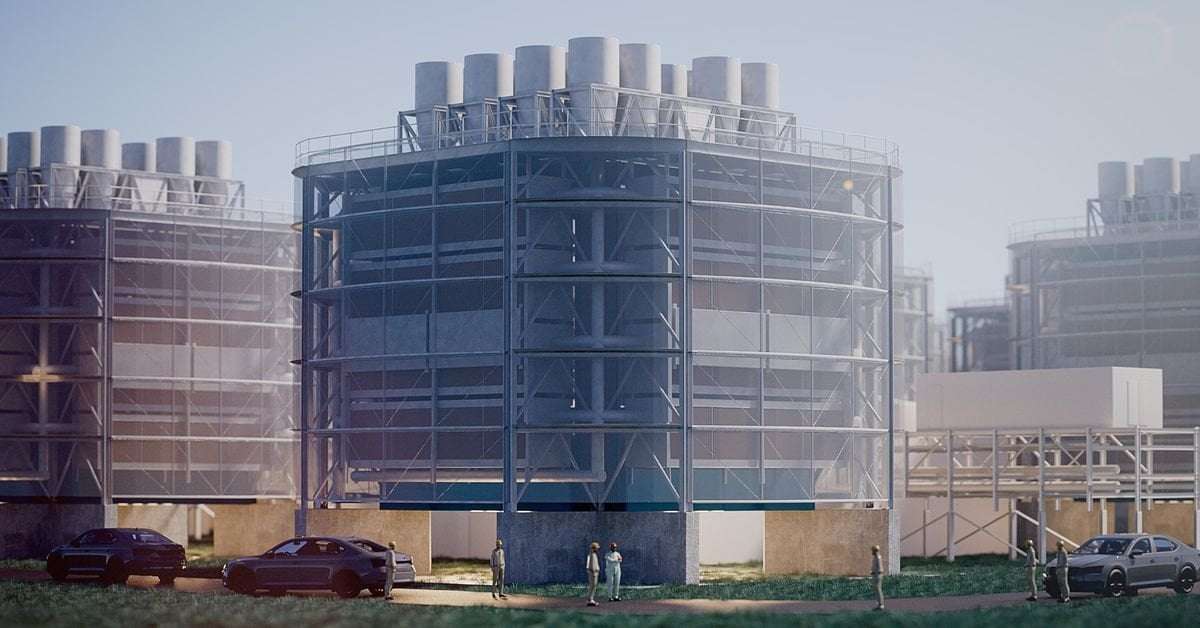
The next generation of industrial plants to filter CO2 out of the air is on the way, and it’s getting closer to overcoming some of the biggest challenges of using this technology to fight climate change. Climeworks, one of the first startups to develop this tech, unveiled its Generation 3 plant today. It’s supposed to use half as much energy as older designs and slash costs in half, too.
It’s supposed to use half as much energy as older designs and slash costs in half
If Climeworks makes good on that promise, it could go a long way toward making this technology, called direct air capture (DAC), a viable way to reduce the amount of carbon pollution building up in the atmosphere. Right now, the technology is far too new and expensive to make a meaningful dent in those emissions. Nevertheless, a slew of big brands and the Biden administration are already placing a lot of faith — and funding — in developing the technology.
Carbon dioxide removal is an umbrella term for a suite of technologies being developed to take carbon dioxide out of the atmosphere. These technologies could potentially help slow climate change by trapping some of the pollution fossil fuels have already released over the years. There are still concerns about its costs, safety, and potential to delay a transition from fossil fuels to carbon pollution-free energy. Experts say carbon removal is no substitute for preventing greenhouse gas emissions in the first place.
Capturing that much CO2 would be fantastically expensive today since DAC costs upward of $600 per ton. A big chunk of those costs comes from the amount of energy it takes to run a DAC plant, which is another concern with the technology. Power grids in the US are already struggling to meet growing electricity demand from EVs, data centers, and manufacturing. Plus, DAC plants create their own carbon dioxide emissions if they run on dirty energy. And if they run on renewables, they risk siphoning that clean energy away from arguably more important uses, like keeping the lights on in homes.
Climeworks says its Generation 3 DAC plants can bring the cost of capturing CO2 down to $250–350 per ton by 2030, although there are additional costs for permanently sequestering the CO2 underground or under the sea so that it doesn’t escape back into the atmosphere. Across the industry, the goal is generally to get down to around $100 per ton to make the technology affordable enough to deploy widely.
Climeworks’ older DAC plants are made up of shipping container-sized modules lined with fans that suck in air. The air passes over a special filter that uses a base to attract and trap carbon dioxide, which is mildly acidic. Once the filter is fully saturated with CO2, the unit heats the filter to about 100 degrees Celsius (212 degrees Fahrenheit) to release the gas. That creates a concentrated stream of CO2 that can be transported and stored elsewhere.
Climeworks says Generation 3 is more energy-efficient because it increases surface contact with CO2 and its filters are supposed to capture more than twice as much CO2 as older filters. The modules are also cube-shaped now to maximize CO2 capture.
The company has been testing the new filters in Switzerland over the past five years, finally running a full-scale test this month. Now, the plan is to deploy the technology at DAC plants in the US before expanding to other countries. The first will be in Louisiana, where the Biden administration chose Climeworks to be one of the first companies it’s giving funds to as part of a $3.5 billion program to develop at least four DAC hubs across the US.
Climeworks now has plans to expand in Australia, it announced during a press briefing today. It’s already developing other DAC projects in Norway, Kenya, and Canada. Its first two commercial-scale facilities are located in Iceland.
bean930 on June 5th, 2024 at 01:09 UTC »
There is a huge public perception problem with CCS technology, and this comment thread showcases why. Engineers and Geologists are out here designing net-zero and negative emissions tech, doing the best they can to combat climate change while the world demands more energy every day.
Carbon capture technology on coal-fired power plants is the most tested version and works well. Capture on natural-gas plants is different and a lower TRL, but has also been demonstrated. Considering that direct air capture (DAC) was birthed like 3 years ago, it is still exorbitantly expensive but is working in demonstration projects. Geologic storage of the CO2 has been safely demonstrated and permanently removed from the atmosphere (since the early 70's actually).
Sunshinehaiku on June 4th, 2024 at 23:44 UTC »
Where does the captured CO2 go?
kernal42 on June 4th, 2024 at 23:42 UTC »
Still a heck of a lot more expensive than not emitting it in the first place.