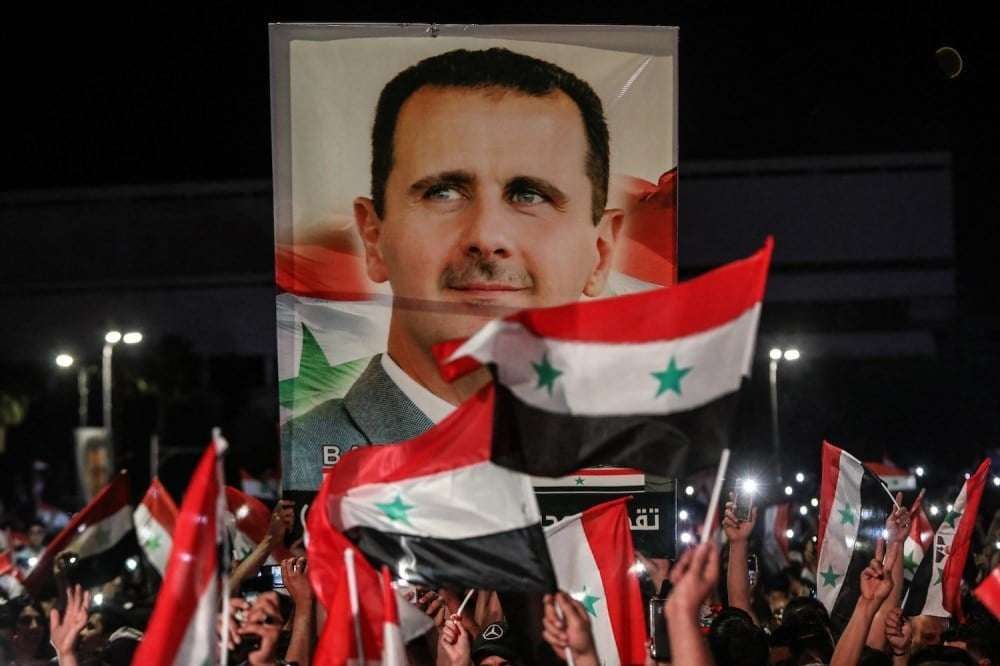
One year ago, Syrian President Bashar al-Assad was welcomed back into the Arab League with considerable fanfare, walking the purple carpet as he joined the summit being held in Jeddah, Saudi Arabia. The decision to readmit Syria to the Arab League after 12 years of isolation was taken amid a major regional push to reengage Assad’s regime, to normalize its diplomatic and security status, and to convince it to help resolve some of the most problematic effects of Syria’s long-running crisis. In his official remarks at the summit in May 2023, Assad celebrated what he called a “historic opportunity … for peace in our region, development and prosperity instead of war and destruction.”
Almost exactly a year later, on May 16 this year, Assad was back at the table alongside Arab League members at a summit in Manama, Bahrain. But this time, he was only permitted to attend on the condition that he stayed silent throughout. The reason? The Arab state effort to bring Assad in from the cold and make his regime a responsible actor had completely backfired. Not only had it failed to convince Assad to make any concessions. Every single aspect of Syria’s crisis has worsened since Assad stepped onto Saudi soil last May.
Shortly before Syria’s readmission to the Arab League, the core Arab states most actively supportive of the normalization initiative met in Jordan alongside Syria’s foreign minister to lay the groundwork for an “Arab leadership role in efforts to resolve the Syrian crisis.” According to the resulting Amman Communique and a series of follow-up documents, the regional initiative identified five core priorities to be accomplished through the work of what came to be known as the Arab Liaison Committee (ALC): increase and expand humanitarian aid delivery; establish conditions necessary for large-scale refugee returns; end the production and export of illegal drugs from Syria; resume the work of the Constitutional Committee and achieve a political solution, in line with U.N. Security Council Resolution 2254; and establish an international security body to coordinate efforts to counter terrorism in Syria.
Since that time, the ALC has met several times, and regional bilateral engagements with Assad’s regime have continued—but work on all five issues has never gotten off the ground. The envisioned “step-for-step” process of reciprocal concessions never went further than the wave of high-profile visits with Assad in early 2023 and his return to the Arab League. When it comes to the political process, not only has there been no progress made, but the Constitutional Committee is now effectively dead, and Assad has repeatedly communicated to Arab states his refusal to engage in any future processes.
In the past year, aid access remains as restricted as ever, while the aid itself is falling to its lowest levels ever, amid huge cuts. Despite 90 percent of Syrians living under the poverty line, the World Food Program has already shuttered its entire effort in Syria, and the U.N. humanitarian response plan is currently just 6 percent funded. Meanwhile, refugees continue to refuse to return to a Syria still ruled by Assad, with U.N. polling indicating just 1 percent would consider a future return if current conditions persist. Feeling increasingly strained, Jordan, Lebanon, and Turkey have turned to differing levels of forceful deportations—violating international humanitarian law.
While deadly conflict continues in every corner of the country, the drugs trade—sponsored and protected by the regime—continues apace, exporting billions of dollars of the amphetamine captagon across the region, utilizing local, regional, and global smuggling routes by land and sea. In fact, the regime-facilitated drug smuggling industry has tripled its rate of smuggling activities on the Jordanian border in the last 12 months. To rub further salt in the wound, within 48 hours of Saudi Arabia’s May 26 appointment of an Ambassador to Syria, approximately $75 million of captagon manufactured by Assad regime actors was seized on Saudi soil, and a further $40 million worth in Iraq.
Not only has the regime’s drug trade continued, but it has diversified, to now include crystal meth and weapons, delivered by drones and sophisticated groups of heavily armed smugglers linked to the regime’s elite 4th Division and allied Iranian proxies. Having been most acutely concerned about the drugs threat, Jordan initially invested in a working relationship with Syrian regime intelligence, but it has now done a 180-degree shift and turned to shooting down drones, engaging in increasingly heavy and prolonged border clashes and conducting airstrikes deep inside regime-held areas of Syria.
With the sense of failure clear, regional states initially sought to engage the United States and European partners on paths forward on Syria, but any energy to do so soon fizzled after Hamas’s assault on Israel and the resulting Israeli campaign in Gaza. This year, previously scheduled ALC summits have been repeatedly postponed amid Syrian regime obstructionism and a refusal by the likes of Jordan to engage. That Jordan is putting up such a wall is unsurprising but also illustrative of the profound failure of the Arab initiative. Jordan’s King Abdullah II was arguably the central architect of the normalizing agenda, his government having presented a white paper on reengagement in 2021 and shopped it around intensively in Moscow, Washington, and elsewhere.
In the United States, interest in Syria policy has waned for years now, but the Biden administration did quietly encourage regional reengagement last year and has effectively blocked Congress from moving forward with the Assad Regime Anti-Normalization Act. Though it opposes normalization in theory, it has done little if anything to stop it, while its intervention in congressional legislation-making has sent concerning signals. As things stand, the Caesar Syria Civilian Protection Act is set to expire in December, and without it, governments and entities around the world would be free to engage and invest in Assad’s regime almost at will. That vacuum requires filling, swiftly.
Ultimately, after more than 13 years, Syria’s crisis remains wholly unresolved, while conditions inside the country are worse than ever before—and continuing to deteriorate. The regional effort to get things moving forward failed spectacularly because it was driven by all the wrong assumptions. That is not to say that diplomacy is of no use, but it cannot work if the regime is awarded unconditionally from the outset. It also requires the collective effort, will, and serious investment of the entire international community. U.S. indifference cannot continue if Syria has any hope of escaping its current disaster.
BinRogha on May 31st, 2024 at 12:04 UTC »
When everyone jumped on the US led bandwagon to let's topple Assad, little did they expect that it would produce a large scale refugee crisis, the formation of DAESH, and expansion of Iranian influence to Syria.
The efforts to rehabilitate Assad is an effort to push him away from Iranian influence. You can alienate him, but he will get more in bed with Iran. This doesn't help either the Arab states nor Israel.
Robotoro23 on May 31st, 2024 at 08:00 UTC »
SS:
A year ago, Assad was readmitted to the Arab League at a summit in Jeddah, marking an end to Syria's 12-year isolation. This was part of a regional effort to normalize relations and leverage Syria's cooperation in resolving its crisis.
Despite the initial optimism, the past year has seen a deterioration in Syria's situation. Assad's regime failed to make concessions, and the Arab League's conditions for his attendance at the latest summit in Bahrain included his silence.
The Arab Liaison Committee (ALC) has seen no progresss,formed to address five key issues
High-profile meetings and Assad's Arab League return did not translate into actionable steps.
Humanitarian aid is at an all-time low, with the World Food Program ceasing operations in Syria. Refugee returns are non-existent due to ongoing poor conditions, leading to forced deportations by neighboring countries.
The Syrian regime's drug trade, particularly in amphetamine captagon, has expanded, with significant seizures in Saudi Arabia and Iraq. Jordan has shifted from cooperation to military action against the regime's smuggling operations.
Regional states initially tried to engage the US and European partners on Syria but lost momentum after Hamas's attack on Israel and the resulting conflict in Gaza. ALC summits this year were postponed due to Syrian regime obstructionism and Jordan's refusal to participate. Jordan's reluctance reflects the failure of the Arab initiative, led by King Abdullah II, who had pushed for normalization efforts since 2021.
Interest in Syria policy in the United States has declined, but the Biden administration did quietly support regional reengagement last year and effectively preventing Congress from advancing the Assad Regime Anti-Normalization Act. The Caesar Syria Civilian Protection Act is due to expire in December, potentially allowing global engagement with Assad's regime.
After over 13 years, Syria's crisis persists without resolution, and conditions inside the country are deteriorating.
The author concluded that the regional effort to progress failed due to flawed assumptions. Diplomacy remains valuable but cannot succeed if the regime is rewarded unconditionally. Resolving Syria's crisis demands collective international effort, will, and investment. Continued U.S. indifference hinders Syria's escape from its current disaster.
Magicalsandwichpress on May 31st, 2024 at 07:45 UTC »
It's easy to break a country, the problem has always been how to put it back together. The Arab league reaps what it sows.