"You've killed me. Bastards, you've killed me! While the sun is still hot, I die!"
Collected on the fifth day of the week Chach of the month Betab of the year 1171, ten seconds before death. Subject was a darkeyed soldier thirty-one years of age. Sample is considered questionable.
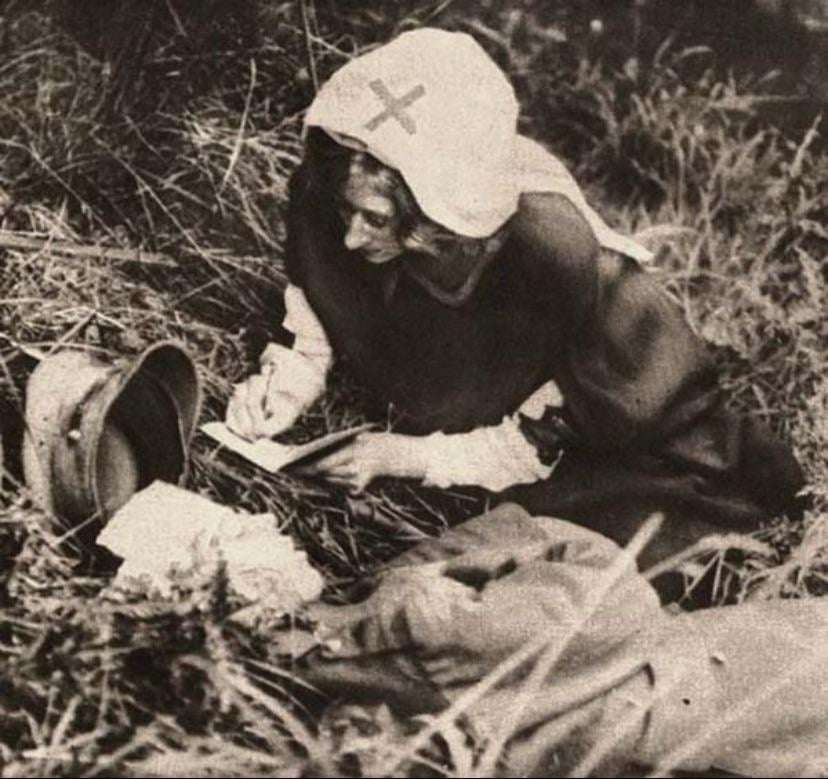
I am just going to say it is probably 1914-1915. This is based on the fact that he has a head wound and his cloth cap with him. Britain and many other countries went into WWI with no appreciation for the shrapnel and debris from artillery, thus head protection was limited to soft caps and officers hats. The metal "Brodie" helmet was introduced in October 1915 and was not widely issued until spring 1916.
EDIT Just to clarify I am not saying this is a British soldier, just that all countries were unprepared for the horrors of WWI and the lack of proper headgear was a clear sign of unpreparedness. The British documentation on the rollout of a “Brodie” helmet is just the best documented one I am aware of. The helmets of the time would not stop a bullet, nor much else, but they could deflect and stop low energy rocks and wooden splinters produced by artillery impacts that otherwise would be fatal.
Its more likely she was documenting his name, time, place of death after a battle. When someone is killed in combat its not like the movies where before they pass they have the time to have a rational conversation.

m777z on May 27th, 2024 at 03:55 UTC »
"You've killed me. Bastards, you've killed me! While the sun is still hot, I die!"
Collected on the fifth day of the week Chach of the month Betab of the year 1171, ten seconds before death. Subject was a darkeyed soldier thirty-one years of age. Sample is considered questionable.trucorsair on May 27th, 2024 at 05:18 UTC »
I am just going to say it is probably 1914-1915. This is based on the fact that he has a head wound and his cloth cap with him. Britain and many other countries went into WWI with no appreciation for the shrapnel and debris from artillery, thus head protection was limited to soft caps and officers hats. The metal "Brodie" helmet was introduced in October 1915 and was not widely issued until spring 1916.
https://www.marlowmuseum.uk/features09/
EDIT Just to clarify I am not saying this is a British soldier, just that all countries were unprepared for the horrors of WWI and the lack of proper headgear was a clear sign of unpreparedness. The British documentation on the rollout of a “Brodie” helmet is just the best documented one I am aware of. The helmets of the time would not stop a bullet, nor much else, but they could deflect and stop low energy rocks and wooden splinters produced by artillery impacts that otherwise would be fatal.
Adventurous_Web_7961 on May 27th, 2024 at 05:37 UTC »
Its more likely she was documenting his name, time, place of death after a battle. When someone is killed in combat its not like the movies where before they pass they have the time to have a rational conversation.