Sign up to our free weekly IndyTech newsletter delivered straight to your inbox Sign up to our free IndyTech newsletter Please enter a valid email address Please enter a valid email address SIGN UP I would like to be emailed about offers, events and updates from The Independent. Read our privacy policy Thanks for signing up to the
IndyTech email {{ #verifyErrors }} {{ message }} {{ /verifyErrors }} {{ ^verifyErrors }} Something went wrong. Please try again later {{ /verifyErrors }}
Seven countries now generate nearly all of their electricity from renewable energy sources, according to newly compiled figures.
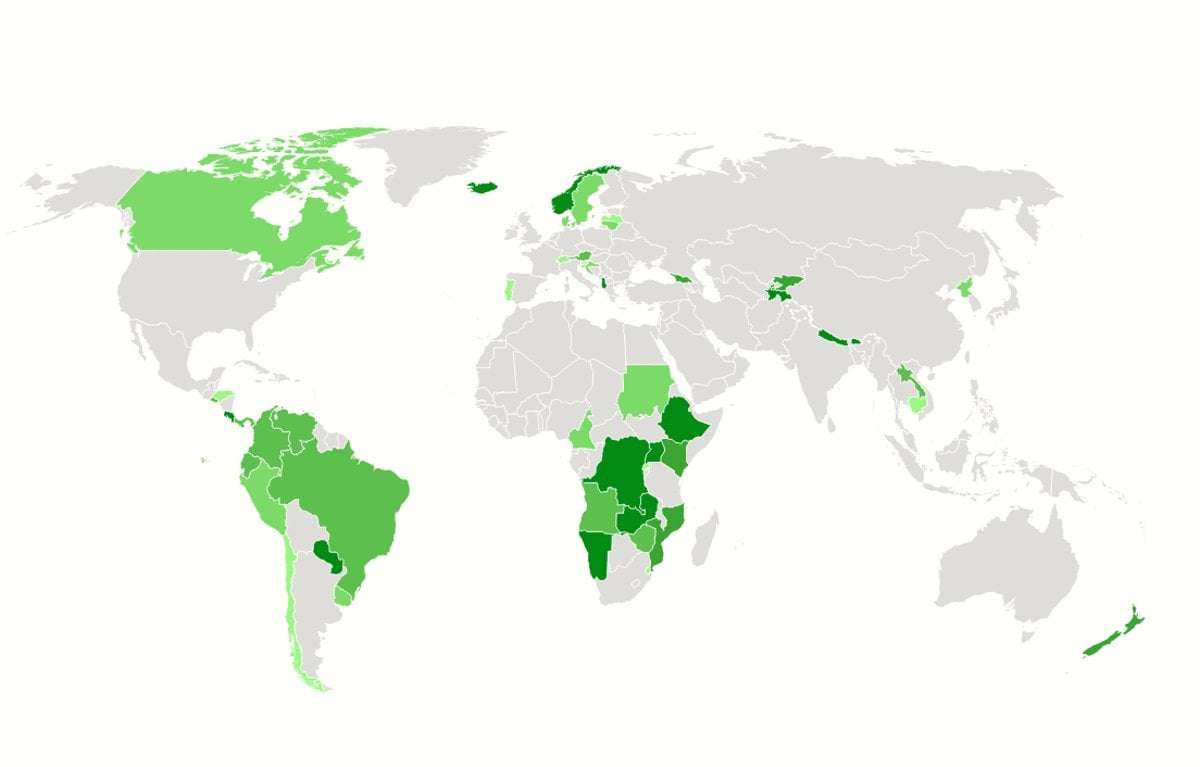
Albania, Bhutan, Nepal, Paraguay, Iceland, Ethiopia and the Democratic Republic of Congo produced more than 99.7 per cent of the electricity they consumed using geothermal, hydro, solar or wind power.
Data from the International Energy Agency (IEA) and International Renewable Energy Agency (IRENA) also revealed that a further 40 countries generated at least 50 per cent of the electricity they consumed from renewable energy technologies in 2021 and 2022 – including 11 European countries.
“We don’t need miracle technologies,” said Stanford University Professor Mark Jacobson, who published the data.
“We need to stop emissions by electrifying everything and providing the electricity with Wind, Water and Solar (WWS), which includes onshore wind, solar photovoltaics, concentrated solar power, geothermal electricity, small hydroelectricity, and large hydroelectricity.”
Professor Jacobson also noted that other countries like Germany were also capable of running off 100 per cent renewable-generated electricity for short periods of time.
Figures released by the IEA in January show that the UK generated 41.5 per cent of its electricity from renewable sources in 2022 – up 10.5 per cent from the year before.
In Scotland, renewable energy technologies generated the equivalent of 113 per cent of the country’s overall electricity consumption in 2022.
Nearly 50 countries now generate more than 50 per cent of their electricity from renewable energy sources ( The Independent )
“These record-breaking figures are a major milestone on Scotland’s journey to net-zero, clearly demonstrating the enormous potential of our world-class renewable energy resources,” Claire Mack, chief executive of Scottish Renewables, said at the time.
While Scotland’s electricity generation was dominated by wind power, researchers predict that solar will come to dominate global electricity supplies over the coming decades.
There has been significant progress in recent years with improving efficiency rates for solar cells, primarily boosted by the so-called ‘miracle material’ perovskite.
Commercial costs have also fallen, which led scientists at the University of Exeter and University College London to claim last year that solar energy has reached an “irreversible tipping point” that will see it become the world’s main source of energy by 2050.
Their 2023 paper, published in the journal Nature Communications, found that technological and economic advances meant the transition to clean energy is not just reachable, but inevitable.
“Due to technological trajectories set in motion by past policy, a global irreversible solar tipping point may have passed where solar energy gradually comes to dominate global electricity markets, without any further climate policies,” the researchers wrote in the study.
“Solar energy is the most widely available energy resource on Earth, and its economic attractiveness is improving fast in a cycle of increasing investments.”
wolftick on May 21st, 2024 at 20:53 UTC »
Iceland basically have geological cheat mode on.
Vitss on May 21st, 2024 at 20:01 UTC »
Not to be a downer, but countries like Ethiopia and the Democratic Republic of Congo have known issues with access to electricity. They might produce 100% of their power from renewable sources, but when less than half of the population has access to it, the achievement is not as great as it might seem.
The good news is that they also have enormous unexplored potential, so if they ever figure out how to grant access to their population, they could very well scale their production up to accommodate the demand.
STFU-Sanguinet on May 21st, 2024 at 19:48 UTC »
Didn't Costa Rica reach that point awhile ago?