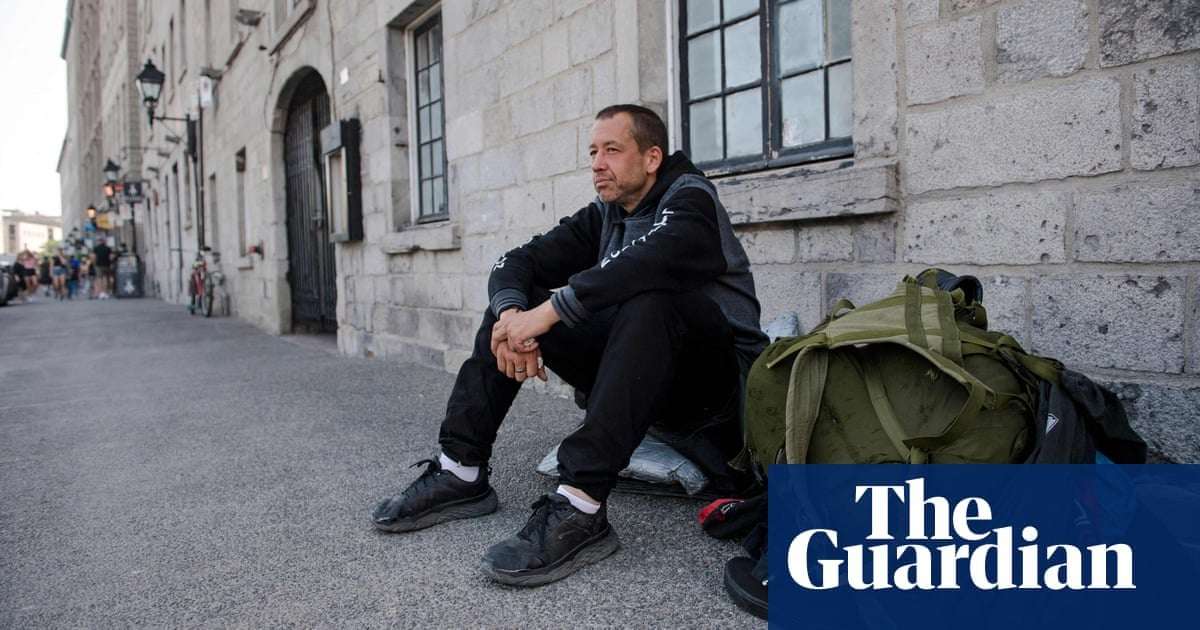
The widely held stereotype that people experiencing homelessness would be more likely to spend extra cash on drugs, alcohol and “temptation goods” has been upended by a study that found a majority used a $7,500 payment mostly on rent, food, housing, transit and clothes.
The biases punctured by the study highlight the difficulties in developing policies to reduce homelessness, say the Canadian researchers behind it. They said the unconditional cash appeared to reduce homelessness, giving added weight to calls for a guaranteed basic income that would help adults cover essential living expenses.
Researchers at the University of British Columbia described in a report for Proceedings of the National Academy of Sciences how they tracked the spending of 50 people experiencing homelessness after they were given C$7,500.
The study built on a previous US survey of 1,114 people that tracked “public mistrust” in unhoused people’s ability to manage money, where participants predicted that recipients of an unconditional $7,500 cash transfer would spend most of it on “temptation goods” such as alcohol, drugs and tobacco.
The Canadian researchers followed up by actually giving that amount to 50 people who were homeless in Vancouver, and compared their spending with a control group of 65 homeless people who did not receive any cash.
They found the cash recipients each spent an average of 99 fewer days homeless than the control group, increased their savings more and also “cost” society less by spending less time in shelters.
“The impact of these biases is detrimental,” Jiaying Zhao, an associate professor of psychology at UBC who led the study, said in a statement. “When people received the cash transfer, they actually spent it on things that you or I would spend it on – housing, clothing, food, transit – and not on drugs and alcohol.”
Researchers ensured the cash was in a lump sum “to enable maximum purchasing freedom and choice” as opposed to small, consistent transfers.
Zhao said the study did not include participants with severe levels of substance use, alcohol use or mental health symptoms, because researchers felt those groups did not reflect the majority of homeless people.
“Rather, they are largely invisible. They sleep in cars or on friends’ couches, and do not abuse substances or alcohol,” said Zhao.
The study comes as lawmakers in Canada are under mounting pressure from advocacy groups to implement a universal basic income project that would help ease a cost-of-living crisis.
In 2017, the most populous province unveiled the Ontario basic income pilot, meant to study the effects of a universal basic income on 4,000 participants. The program was subsequently shut down by the province’s Progressive Conservative party after an electoral victory, with one minister calling the guaranteed funds a “disincentive” to work.
A bill is currently before the country’s senate to require Canada’s minister of finance to examine the idea of a nationwide basic income project and report on possible benefits.
Original-Ad-4642 on August 31st, 2023 at 01:15 UTC »
Give money to homeless shelters!
I can’t stress this enough.
The shelter can stretch a dollar much farther.
Your donation is tax deductible.
You know your money isn’t being misspent.
If you look, you can sometimes find matching funds to double the power of your donation.
Throwaway-646 on August 30th, 2023 at 23:27 UTC »
This is so misleading. The only people given money were ones already in shelters, not using substances or alcohol, no mental health symptoms, and homeless for less than 2 years. They also all got phones and half got additional coaching. Of course they're going to spend it on food, clothes, housing etc. They're the portion of homeless people that wanted and strived for that anyways. Imagine how different the results would have been if they gave the money to the first 50 people they saw.
04221970 on August 30th, 2023 at 21:36 UTC »
The disconnect people are seeing is that who they see as homeless are really not the majority. THe majority of homeless are like I was.....couch surfing, living off the good will of friends and motivated to get out of that position.
You don't see me begging on the street or in unkept clothes, I'm just a regular guy.
So the problem is that THERE ARE A LOT MORE PEOPLE who are homeless than you know about, and the only ones you see are the ones that provide you with a bad stereotype.
THe issue with this study is that they would have helped me and others like me, who would have and did get my shit together and get back on track.
BUT this program wouldn't have done jack shit for the ones on the street that you see and feel like you want to avoid.
The study intentionally didn't help those people.
Edit: I feel I have to add this. The researchers essentially cherry picked the group of homeless that didn't need it the most. I would have and I did dig myself out of my situation. I would have gladly taken the $7500 and would be counted a success story and reason to give the money to the homeless. BUt I did it anyway on my own. I fear this study would be used as evidence that giving money to homeless who are drug addicted with mental problems will be the solution....when it really won't. If you give the money to the chronically homeless I'm pretty sure the results will be different.