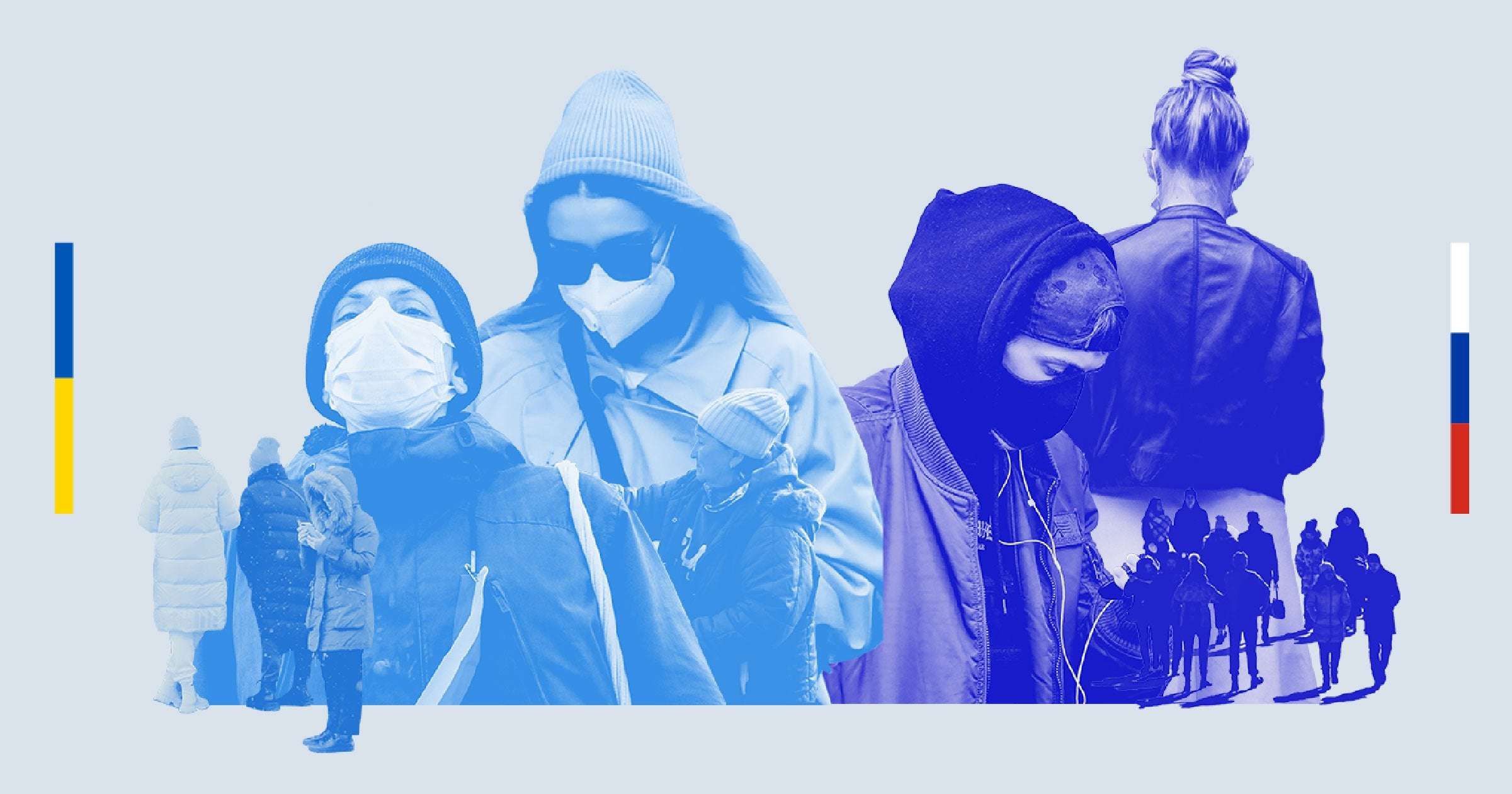
Exclusive CNN poll Half of Russians say it would be right to use military force to keep Ukraine out of NATO
(CNN) â As the world waits to see if Russia will invade Ukraine, an exclusive new poll of both countries for CNN finds that twice as many Russians believe it would be right for Moscow to use military force to prevent Kyiv from joining the North Atlantic Treaty Organization (NATO) as say it would be wrong.
One out of every two Russians (50%) says it would be right, while only a quarter (25%) say it would be wrong. The other quarter (25%) are unsure, according to the survey.
But the poll also found that more Russians think it would be wrong than right to use military force âto reunite Russia and Ukraineâ â two countries with a long and complicated history of being intertwined.
Itâs a close call, but 43% of Russians said use of military force against Ukraine to join it to Russia would be wrong, while 36% said it would be right. (The rest of the respondents said they didnât know if it would be right or wrong.)
Perhaps unsurprisingly, most people in Ukraine disagree with the use of force against them. Seven out of 10 respondents there said it would be wrong for Russia to use military force to prevent Ukraine from joining NATO (70%) or to reunite the two countries (73%).
One in two Russians feels the use of force is justiï¬ed to keep Ukraine from joining NATO We asked: Would it be right for Russia to use military force ... ... to prevent Ukraine from joining NATO Yes Don't know No Russian respondents 50% 25% 25% Ukrainian respondents 13% 17% 70% Yes Don't know No ... to âreunite Russia and Ukraineâ Russian respondents 36% 21% 43% Ukrainian respondents 13% 14% 73% ... if Russia feels threatened by foreign activity in former Soviet countries Russian respondents 50% 27% 23% Ukrainian respondents 10% 20% 70%
And most Ukrainians reject Russian President Vladimir Putinâs assertion in a speech on Monday that their country has no historical basis and is essentially a creation of the Soviet Union.
Across the country and across all ages, a majority of Ukrainians say they are not âone peopleâ with Russians and that the two countries should not be one.
The survey, of more than 1,000 people in each country, was carried out online from February 7 to 15, before Putinâs speech Monday and Moscowâs recognition of two breakaway separatist republics in Ukraine.
Many in Russia believe their country would be fundamentally threatened by further expansion of NATO to Ukraine, according to veteran Russian and Soviet-era TV host and journalist Vladimir Pozner.
âIt speaks to the view that, should Ukraine become a NATO member, and should NATO forces be deployed on Russiaâs doorstep, that would constitute an existential threat and therefore cannot be allowed,â Pozner told CNN by email.
Orysia Lutsevych, head of the Ukraine Forum at the Chatham House think tank in London, painted a darker picture of the Russian perspective.
âModern-day Russia has a syndrome of collapsing empires,â she told CNN by email. âThe loss of these lands is presented as âhistorical injusticeâ that should be rectified, including by force. Ukraine is viewed as a crown jewel that is âbeing stolen by NATO.â Tapping into old Soviet scaremongering of the US and NATO, Russians believe it is an aggressive bloc that is in a way of Russia-Ukrainian unity.â
Contrary to Western warnings that Russian President Vladimir Putin is putting forces in place for an attack on the countryâs western neighbor, only 13% of Russians think the Kremlin is likely to initiate military action towards Ukraine.
Most Russians also do not expect a Ukrainian attack on their country -- only 31% of Russians said that was likely. In fact, two out of three (65%) expect a peaceful end to the tensions between Russia and Ukraine.
âThe reason why 75% of Russians think Russia will not invade Ukraine is simply because of what they read in their newspapers and see on their TV. There is basically no hysteria, no beating of the war drum, a consistent message that we do not want a war and will not start one,â Pozner said.
Pozner said Russians are neither naïve nor ignorant of Western leadersâ warnings that Putin is considering invading Ukraine.
He explained: âRussians know what Western leaders are saying. Their statements are widely featured in the media. The general feeling is that the West in fact wants Russia to attack Ukraine because that would be to the Westâs advantage, it is goading Russia to attack.â
But Pozner argued that Russians understand an invasion of Ukraine would be costly.
âThey are also of the opinion that, while Ukraine could not stand up to an all-out Russian invasion, Russia would lose much more from that than any military victory would win,â he said.
Most Russians expect a peaceful end to the conflict â Ukrainians are undecided We asked: Are either of these scenarios likely or unlikely ⦠⦠Russia initiating military action towards Ukraine in the near future Likely Don't know Unlikely Russian respondents 13% 12% 75% Ukrainian respondents 42% 13% 45% Likely Don't know Unlikely ⦠Ukraine initiating military action towards Russia in the near future Russian respondents 31% 12% 57% Ukrainian respondents 13% 10% 77% ⦠a peaceful end to tensions between Russia and Ukraine Russian respondents 65% 14% 21% Ukrainian respondents 43% 14% 43%
However, according to Lutsevych, the prevalence in Russia of the view that their country was not going to invade Ukraine may illustrate âhow Russian state-controlled media and disinformation is shaping an alternative reality for the Russian population.â
âInside Russia the West is presented as a villain that is abusing Ukraine to undermine Russiaâs greatness. In the event of Russian military aggression, Russia will be portrayed as fighting the US and NATO forces, and not killing its Slavic brothers,â Lutsevych said.
To be sure, Russiaâs state-dominated television is a major factor in influencing Russian public opinion â and Russian media have largely toed the official line when it comes to presenting Putinâs vision of Russian-Ukrainian âunity.â
But Russian pollsters have in recent years also noted that younger audiences get more information from the internet, social media and other sources that are not controlled by the state.
Meanwhile, fewer Ukrainians than Russians believe there will be a peaceful end to tensions â only 43% expect that.
But Ukrainians are divided about the possibility of Russia starting a war â 42% expect that, while 45% think it is unlikely. (The remaining 13% say they donât know.)
More than half of Russians (57%) and three-quarters of Ukrainians (77%) think Ukraine is unlikely to initiate military action towards Russia in the near future, with just 31% in Russia and 13% in Ukraine saying they think it is likely that Ukraine will instigate military conflict.
Russians and Ukrainians do not even agree on whether there are Russian military forces in the separatist-controlled eastern areas of Ukraine known as the Donbas: three quarters of Ukrainians (73%) believe there are Russian troops there, as opposed to one in five Russians (19%).
Younger Russians were more likely than the general population -- at 28% -- to say their troops were in the Donbas.
The poll was completed before Putinâs announcement that Russia would send what he called âpeacekeepersâ into the regions.
Russia had maintained for years that it had no soldiers on the ground there, but US, NATO and Ukrainian officials say the Russian government supplies the separatists, providesâ¯them with advisory support andâ¯intelligence, and embeds its own officers in their ranks.
Underlying the immediate crisis, Russians and Ukrainians have markedly different views on the relationship between the two countries and their populations.
Two out of three (64%) Russians say Russians and Ukrainians are one people, a position taught in the Soviet era.
Two thirds of Russians think of themselves and Ukrainians as âone peopleâ â yet not even a third of Ukrainians agree We asked: Do you view Russians and Ukrainians as âone people?â Yes Don't know No Russian respondents 64% 10% 26% Ukrainian respondents 28% 6% 66% Yes Don't know No
Even before his speech on Monday, Putin had been pushing the view that the two peoples are one, particularly in a tendentious essay last summer.
He claimed âthe idea of Ukrainian people as a nation separate from the Russiansâ was formulated by intellectuals as recently as the 19th century, disregarding the nationsâ complex history by asserting: âSince there was no historical basis â and could not have been any, conclusions were substantiated by all sorts of concoctions.â
Putin argued that Soviet-era âlocalization policyâ emphasized regional differences, implying those differences had little historical basis.
âTherefore, modern Ukraine is entirely the product of the Soviet era,â he insisted.
Historian Timothy Snyder of Yale University dismissed Putinâs entire argument out of hand.
âThe problem with the Putin essay is that it is so thoroughly wrong on everything that it is hard to know where to begin,â he told CNN in an email, citing an example of the use of the term âUkraineâ as far back as 1648.
If anything, he said, it is the idea of a Russian nation-state that is a modern construct, not that of Ukraine.
âRussia was not a national idea in the 19th century. It was an imperial idea. Smuggled into the essay is the notion that there was a Russian nation, in the modern sense, against which Ukraine defined itself. But there was no such Russian nation in the 19th century,â he said.
Regardless of the historical debate, Ukrainians tend to think of themselves as a separate people, CNNâs poll found.
Just over a quarter (28%) of people in Ukraine say Russians and Ukrainians are one people, while two thirds (66%) say they are not â a mirror image of the view from across the border.
Snyder argued that on this topic, the Ukrainian view should prevail.
âThe voice of the smaller people matters more. A larger country claiming a smaller country is called imperialism,â he told CNN by email.
âRussians tend to say Ukrainians and Russians are one people because (1) they generally have had little contact with Ukraine and (2) this is what their president says and very similar to the Soviet line,â Snyder said.
No region of Ukraine, and no age group, has a majority where respondents say Russians and Ukrainians are one people.
Even in eastern Ukraine, which borders Russia and is partially controlled by Russian-backed separatists, fewer than half (45%) of respondents said they agree that Russians and Ukrainians are one people â a score much lower than in Russia.
No region in Ukraine says Ukraine and Russia should be one country Eastern Ukraine has a higher share of people (45%) who see themselves as âone peopleâ with Russians compared to western Ukraine, but even there, it is not a majority view like in Russia (64%). “Russia and Ukraine should be one country” Percentage of respondents who agree “Russians and Ukrainians are ‘one people’” Percentage of respondents who agree Note: Responses from administrative regions in this map have been been combined to Northern, Western, Central, Eastern, and Southern wider regions to ensure sample sizes are representative. Source: CNN/Savanta ComRes
Even as Russians tend to say Russians and Ukrainians are one people, a majority of Russians (54%) say they should be two countries â although a third (34%) say they should be one country. The remaining 12% say they do not know.
Ukrainians overwhelmingly feel Russia and Ukraine should be two separate countries, with 85% saying so, 9% saying they should be one country, and 6% responding that they did not know.
Russians are more likely than Ukrainians to support changing the borders of the two countries so that regions in Ukraine where people may âfeelâ more Russian could formally become part of Russia.
Again, the views across the border are mirror images of each other: two thirds (68%) of Russians would support changing the borders and 8% would oppose it, while two thirds (64%) of Ukrainians oppose it and 13% support it.
Neither a majority of Russians nor Ukrainians say the two countries should be one, but one in three Russians does think so We asked: Should Russia and Ukraine be one country? Yes Don't know No Russian respondents 34% 12% 54% Ukrainian respondents 9% 6% 85% Yes Don't know No
Russians and Ukrainians also differed on their views of the Soviet Union.
Seven out of 10 Russians (71%) say the Soviet Union was a positive thing, while one in 10 (9%) say it was negative, while Ukrainians were evenly split: 34% said it was positive and 35% said negative. The remainders in both countries were neutral or undecided about it.
Thereâs a generational divide on the question in Ukraine, where 41% of people aged 55 and over â old enough to remember the Soviet Union â see it as having been a positive thing. Only a quarter (23%) of 18 to 34-year-olds in Ukraine â people born after the collapse of the USSR, or very young children when it dissolved in 1991 â see it as having been positive.
The differing views of the USSR stem from different relationships with it, Snyder said.
âThe Russian leadership tends to define Russia as the successor state of the Soviet Union. More so than Ukrainians, Russians have a difficult time defining a history without the Soviet Union at the center,â the Yale historian said.
âRussians tend to accept that the Soviet Union had policies of terror, but believe that the costs of these were borne equally throughout the USSR. In Ukraine, people tend to believe that the Holodomor of 1932-1933, a political famine engineered by Stalin, was targeted at their country in particular.â
An overwhelming majority of Russians have a positive view of the Soviet past, while Ukrainians are divided on this We asked: Do you consider the Soviet Union to have been a positive or a negative thing? Positive Donât know/neutral Negative Russian respondents 71% 20% 9% Ukrainian respondents 34% 31% 35% Positive Donât know/neutral Negative
Despite the wide gulf in their views of each other, Russians and Ukrainians do see eye to eye on some topics.
Given a list of nine characteristics, Russians and Ukrainians tended to agree on which ones Putin and Ukrainian President Volodymyr Zelensky embodied â with some notable differences.
âStrongâ and âdecisiveâ were the second and third most popular answers for Putin among both Russians and Ukrainians. The number one choice was radically different: Russians chose âclever,â while Ukrainians chose âdangerous.â
The majority of Ukrainians picked only âfriendlyâ and âcleverâ as descriptions of their own president, with some 40% also selecting âpragmaticâ and âresponsible.â Meanwhile, Russians didnât rank Zelensky high on either characteristic, with a third (35%) â similarly to Ukrainians themselves (32%) â describing him as âdangerous.â
Opinions divided sharply on US President Joe Biden. Ukrainiansâ most common descriptions of Biden were âclever,â âstrong,â and âresponsible,â while most Russians didnât score him high on any of the characteristics. Half (47%) of Russians called Biden âdangerous,â as did a third (32%) of Ukrainians.
Both nations see Putin as âstrongâ and âdecisiveâ â but Ukrainians also think of him as âdangerousâ We asked: Does this politician embody each of the following characteristics? Respondents from: Russia Ukraine Volodymyr Zelensky President of Ukraine Vladimir Putin President of Russia Joe Biden President of the United States Source: CNN/Savanta ComRes
Majorities in both countries (57% of Russians and 61% of Ukrainians) described themselves as optimistic about the future for themselves and their families, while roughly a third of Russians and Ukrainians (37% and 32% respectively) described themselves as pessimistic.
Mrbeardoesthethings on February 23rd, 2022 at 09:05 UTC »
Remember Russian news outlets are running N.A.T.O as the aggressors in the region.
damnhowdidigethere on February 23rd, 2022 at 08:28 UTC »
Unfortunately I think many russians simply don't know what it entails when russia launches a full invasion of Ukraine. They are gonna be the ones suffering in the cold while Putin and the oligarchs will still be rich.
molokoplus359 on February 23rd, 2022 at 08:27 UTC »